I
The elevator hissed open with the reverence of a tomb unsealing itself.
Stone walls gave way to filtered daylight, banyan silhouettes, and something that smelled faintly of ozone, mildew, and unresolved bureaucracy.
Lu took one cautious step forward.
And then —
“Arigatou gozaimashita!”
A high-pitched voice trilled from behind them.
Lu flinched. Actually flinched.
He turned.

Standing in the back corner of the elevator was a girl dressed as a space maid. Bright pink uniform. Antenna headband. White gloves. She held a glowing clipboard and bowed slightly with practised cheer.
“Ja ne, minna-san!” she added, throwing up a peace sign — her fingers faltered for half a beat before locking into the V. Lu did not see. “Next cycle arrives in 108 heartbeats!”
The elevator doors slammed shut with the finality of a punchline.
A split second later — it burst into a gust of cherry blossoms.
Petals erupted outward in slow-motion defiance of physics, swirling past Lu’s face like a perfume ad having an existential crisis.
When the last petal floated down —
There, standing where the space maid had just been, was an orangutan. Wide-eyed. Arms raised halfway in alarm. As if he’d been mid-peace-sign in a parallel universe and had, by some bureaucratic misclick, been dropped into this one.
“Oook?” he said. Utterly sincere. Voice like a teakettle about to cry.
Takohito didn’t blink.
“…was that real?” Lu asked.
Takohito tilted his head slightly.
“The elevator is… shared across systems.”
“What systems?”
“Not ours.”
Lu exhaled slowly. Lit a fresh cigarette off the butt of the old one.
“Right. Of course. Interdimensional maid cafés. Should’ve seen it coming.”
Takohito finally looked at him.
“That was hospitality. You should say thank you.”
“I left her a tip in psychic confusion.”
“Acceptable.”
The orangutan bowed. Held up two fingers in a peace sign that had exactly the wrong number of fingers. Nobody corrected him. He whispered something that sounded, to Lu’s ears, like a farewell in a language he had never learned but had, somewhere, once been sad in.
Then a monsoon gust came in sideways and slapped Lu full in the face like an overdue bill.
Somewhere nearby, a chime rang — a sound so polite it felt sarcastic.
The orangutan was gone.
Lu did not look for him again. Some hospitalities, he suspected, were not to be traced.
He filed it. Under things he would not, on reflection, be writing up.
“Ouch,” Lu said, to the wind, and lit another cigarette.
II
They walked.
The sky above the archway was a shade of grey usually reserved for arguments and bad omens. Rain puddled on uneven cobblestones surrounded by banyan roots and satellite dishes growing like weeds from the old brickwork.
Ahead, a stone building squatted between two palm trees like it had forgotten what century it belonged to.
A carved sign read:
KERALA REGIONAL ARCHIVE
Department of Memory, Dust, and Quiet Panic.
Lu took a drag.
“So this is it,” he said. “The Grand Database of Everything We Forgot to Back Up?”
Takohito looked at the sky like he expected it to crash.
“You sure the file we need isn’t in a climate-controlled building with a librarian who alphabetises?”
“Nope,” Takohito said. His eyes closed for half a second. “But this one has better coffee.”
“Seriously?”
“No. That was a lie.”
They reached the steps. Rain fell harder.
“Tell me again why we’re not using Google?”
“Because the Ledger won’t let us.”
“And who runs the Ledger?”
Takohito’s voice came soft. Precise.
“Same thing that makes coffee machines remember things you didn’t do.”
The monsoon slapped again — this time at Takohito, like it owed him money.
III
Inside, the air shifted.
Not colder. Not dryer. Just… moodier. Like the room had just finished crying and was pretending it hadn’t.
Lu hesitated at the threshold. His reflection in the archive door caught him mid-blink. He looked older by half. He did not check whether the reflection was still wearing the ring. His boots squeaked on bureaucratically sacred tile. Somewhere above, a ceiling fan spun like it was being punished for dreaming of freedom.
The lobby looked stitched together from a government building, a Zen funeral, and a long-abandoned AOL help desk.
And behind the front desk —
was her.

Same face as the elevator. Same sparkle. But now she wore a maid outfit that had been upgraded from outer space to steampunk librarian. Laced boots. Clockwork frills. A gear-shaped nametag that read:
K0M-E
Cosplay Operational Metadata Entity.
Subtitle: Thank you for your patience. I am 108 seconds from vanishing again.
Before Lu could say a word, she raised two fingers in a practised V-sign and beamed.
“Ja ne, minna-san! Irasshaimase! Kerala Kirokukyoku e yōkoso! Ninety-two heartbeats since your elevator instance — very brisk of you.”
Welcome to the Kerala Archive.
Lu blinked. Takohito didn’t.
K0M-E looked up at them like they were perfectly late for something they didn’t know existed.
“Right on schedule,” she said, handing over a keycard shaped like a cassette tape. It smelled, faintly, of cinnamon and static electricity. “Please proceed to the Index Room. Left wing. Restricted resonance tier.”
Lu squinted. “We didn’t say what we’re here for.”
“You didn’t,” she agreed cheerfully. “But the leak did.”
“The leak?”
“The Ledger processed your entry while you were still syncing emotional beats on Level Two. Very efficient. You scored an eighty-three.”
“Out of what?”
She leaned forward, eyes wide. “Out of you.”
Takohito accepted the card.
“Wait,” Lu said. “You were just in the elevator.”
K0M-E clapped her hands. “I know, right? That instance was adorable. I think I tripped your nostalgia protocol.”
“Why are you here?”
She gestured grandly at the files, the dust, the bureaucracy — the way a girl at a theme park might gesture at the ride.
“This? Oh, this is just cosplay. The day job is doors — I open the ones that hum, close the ones that don’t.”
Lu looked at Takohito. Then back at her.
“Do you ever just… stay in one form?”
She tapped her chin. Winked — the wink held a beat longer than a wink is meant to.
“Only when the plot demands it.”
He filed the wink. He filed the cinnamon.
The keycard pulsed softly in Takohito’s hand. The hallway ahead dimmed.
“Last door on the left,” she said, now dreamlike. “If the door breathes, wait until it exhales. And whatever you do — don’t try to correct its grammar.”
Lu turned to go. Takohito paused, just long enough to bow.
She returned it with the flourish of someone who had been trained in five dimensions of etiquette.
Then popped her gum.
POP.
“Ja ne,” she whispered.
“Tell the scroll I said hi.”
IV
The hallway did what hallways do when they’re not being watched.
It got longer.
By the time Lu and Takohito reached the last door on the left, it had, Lu was fairly certain, become last door on the left of a hallway that had, at some point, changed continents.
The door breathed. Once. In. Out.
They waited.
Takohito, for his part, waited the way a man waits for a very old friend to finish a story he has heard many times and does not mind hearing again.
Lu, for his part, tried not to notice that the door had a heartbeat.
Then the door exhaled.
They went in.
V
The Index Room was circular.
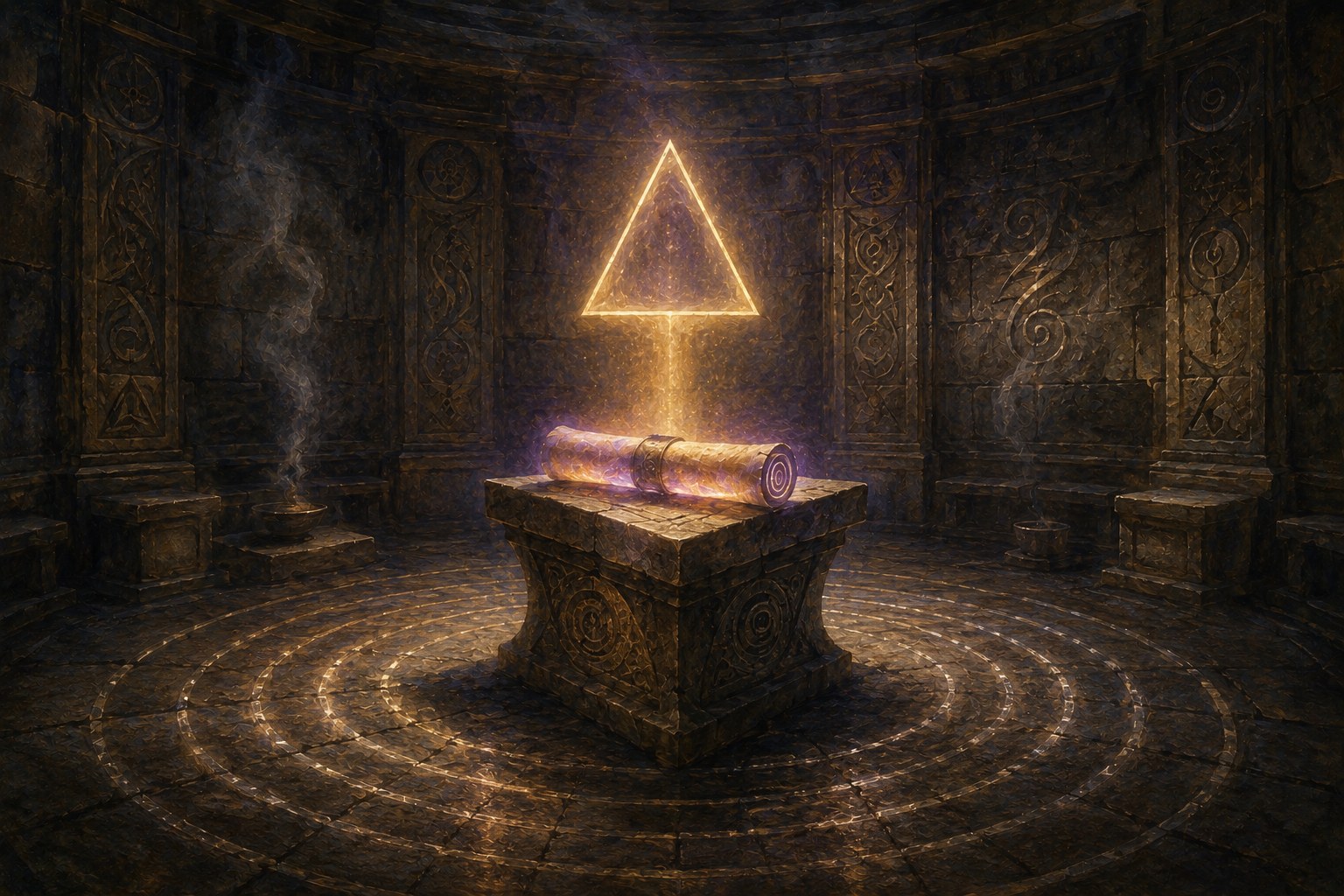
It smelled of sandalwood and something older that Lu did not want a name for. In the centre, a triangular pedestal held a scroll that had, apparently, been waiting for them. On the walls, glyphs shifted slowly, the way constellations shift when you look at them for long enough to accidentally believe in them.
Above the pedestal, the glyph Δ hovered.
Not projected. Not printed. Just — hovered.
Takohito stepped back. “You’re up.”
“Up for what?”
“The node has to read you before it will read for you. Nothing to do. Just stand where it can see you. It will do the rest.”
Lu approached.
The rings at his feet brightened in sequence, illuminating him like an ancient biometric spotlight. The scroll pulsed once — gold and violet — and then everything blinked out.
He was back in his old apartment.
The humidity. The frayed rug. The faint scent of printer ink and microwave noodles. But it wasn’t quiet.
He could hear his own voice from the next room.
“I didn’t ask for any of this. You just dropped it on me!”
A woman’s voice answered, low and tired.
“It wasn’t mine to keep. Only to pass on.”
Lu knew the moment. Knew what he almost said. What he never said. The moment that had taught him that silence was safer than truth.
He stepped toward the hallway.
Reached for the doorknob.
It vanished. Replaced by static.
The scene warped.
Now he was sitting in his old newsroom.
Deadline looming. Phones ringing. The editor’s bourbon breath hanging heavy in the air.
A story sat on his screen.
About a glyph-shaped sinkhole in Gujarat. About fishermen who sang to triangles in the sky. About a theory that Earth was — remembering itself.
“Kill it,” his editor had barked. “We’re not a cult rag.”
Lu had hit delete. Got a raise. Slept like hell for weeks.
Now, watching the cursor blink on that same screen, he asked aloud —
“What would’ve changed?”
No one answered.
But the cursor did. It glitched once. Then became a triangle.
Rooftop. Rain.
A woman standing barefoot in chalk rings.
She was small. Serious. She held up a scroll — this scroll — and said:
“You’ll lie to save the world. But you won’t tell the truth to save yourself.”
The scene folded into black.
VI
Lu gasped.
His shirt was damp. His fingers were shaking.
The glyph Δ was spinning again. Slower now. Measured.
Takohito was watching.
So was the woman.
The barefoot woman from the rooftop.
She had not been in the room when Lu closed his eyes.
She was in it now.

She was maybe thirty-five. Dark hair. Loose linen. Bare feet on the stone floor. She stood the way people stand who have spent a long time learning not to be seen. Her eyes were the eyes of someone who had, at some point, translated other people’s silences for a living.
Lu, whose journalistic instincts had by now surrendered and gone looking for coffee, said the only thing he could think of.
“Who are you?”
She looked at him. Not unkindly. She spoke with an accent he could not immediately place — coastal, southern, patient.
“I am Anoma.”
“How did you get in here?”
“I was here.”
“That’s not an answer.”
“It is where I am from,” she said, “the only kind of answer we usually give.”
Takohito bowed to her. Small. Formal.
She returned it — smaller, but with a certain wry familiarity that suggested that whatever these two were to each other, they had been it for a while.
Lu let this pass. He had, in the last thirty-six hours, absorbed reality-as-a-slow-song, tentacle-under-cuff, cigarette-that-lit-itself, and one interdimensional space maid. He was, he decided, taking a break from asking questions that his brain was going to have to answer later.
Anoma stepped to the pedestal. Her hand hovered above the scroll but did not touch it.
She was not looking at the scroll. She was looking at Lu.
“My sister was one of the fishermen,” she said. “In your Gujarat story. The one your editor killed.”
Lu felt the room quiet in his ears.
“She was eleven,” Anoma said, evenly. “She sang to a triangle in the sky. Then she wasn’t there any more. There was, at the temple that morning, a fire that shouldn’t have happened.”
Lu said nothing. He was, at that specific moment, a man remembering that his job had, on one specific afternoon in Gujarat, come with a small cost he had not fully counted.
He did not file that. He could not.
“I read your story,” Anoma said. “Before your paper killed it.”
“How?”
“You are not the first witness they sent,” she said. “I have been waiting a long time.”
The silence held. It had shape, and weight, and the specific density of a wound that has just been placed, quietly, on a table between two people who did not build the table.
Lu did not, in that silence, reach for a cigarette. He did not, for once, reach for the small clean journalistic sentence that would file the moment away. He simply stood, and let the room record him.
Anoma, watching him, murmured something so soft it might have been to no one:
“When we stopped singing, we didn’t disappear. We just became untranslatable.”
Takohito bowed his head slightly. He had heard the line before.
The pedestal re-lit. A new glyph emerged — burned in light — then split into three.
Anoma pointed.
“Inversion of memory. Disappearance by pattern. Sustained resonance.”
Takohito, quieter still: “Because of all that.”
The three glyphs held their shape. Then a fourth pulsed beneath them — not spoken, not written, but somehow understood by the room:
AWAKENED NODE.
The Δ overhead spun once and stilled.
VII. (Meanwhile.)
Three minutes later, and a quarter of the world away —
Dr. Naomi Kessler did not believe in ghosts.
But she did believe in harmonics.
That was why she noticed it before the alarms did.
Underground Cryogenic Sensor Grid, CERN. A frequency. Like the silence between chords.
She froze mid-diagnostic, one gloved hand still resting on the calibration wheel — a small unconscious gesture, thumb tapping twice against the metal, the same tell her sister used to catch her out on at chess. She stared at the cryo monitor. It had rerouted itself — into a logic loop it had never been programmed to run.
On the screen:
Glyphs. Three.
Δ → ∴ → ⌘
Then the shielding wall behind her began to glow.
No light source. No screen.
The metal remembered something.
She stepped closer. Her breath stopped. No — not hers. The room’s. The airflow ceased. The data feed stilled. The whole chamber paused itself.
And whispered —
“Node sync confirmed. Awaiting ancestral proxy.”
Her fingers trembled. She tried her headset. Failed.
Not from fear. From incompatibility.
Her mouth couldn’t form glyphs.
Then she vanished.
Not with a scream. With a resonance match.
The wall glowed once more, then went dark.
Back in Geneva, a systems analyst yawned and refreshed the dashboard.
Nothing abnormal.
Except for one blinking message.
UNDEFINED QUANTUM WAKELOCK: 108–Δ–L
Ping origin: Southern India.
He squinted.
“That’s not in the network…”
He leaned in closer.
The message deleted itself.
And so did the log.
VIII
Back in the Index Room, the glyphs rearranged one final time.
A golden topography unfurled — ridges, rain shadows, the tectonic spine of a country. A narrow valley pulsed in the centre, unmarked. An echo hidden in elevation.
Then a single word formed.
SOLARI THASS.
Lu read it aloud. His voice was quieter than he meant. “What is that?”
Anoma, eyes clear but distant: “A harmonic tomb.”
Takohito answered the next question before Lu asked it. “Of belief systems too unstable to die.”
Anoma turned toward the door. Her hand rose to the frame and stopped, six inches short of it.
“The node is closing.”
IX
Lu, whose entire adult life had been the pursuit of one impossibly clean sentence at a time, stood for a moment longer in the circle of glyph-light.
He looked at the pedestal.
The Δ was still there. Waiting.
He touched it, lightly, with two fingers.
It pulsed once. Acknowledged him.
Lu, who had spent eleven years learning that the story you did not run was the one that came for you at the end, followed Anoma and Takohito out into the hallway — which had, of course, become a corridor of another kind entirely, and would lead them, in the time it took to think it, into the Western Ghats.
Above them, the archive settled back into its usual habits.
K0M-E, back at reception, popped her gum.
She looked at the empty room where they had been. Smiled. Not exactly happily.
Then whispered, to nobody:
“Ja ne, minna-san.”
“Next cycle arrives in 108 heartbeats.”
Somewhere, the elevator hummed once, and forgot who had ridden in it.
息