I
Back in the tomb, the glyphs rearranged.
A new one hovered. Triangle over spiral. Spiral over hollow.
Anoma stared. Her hand rose and stopped, six inches from the glyph. “That’s a location glyph.”
“Where?” Lu asked.
Takohito already had the scroll open. “Not a where.”
“Then what?”
“A memory that thinks it’s a place.”
The glyph solidified. A new word appeared below it.
E. LEMURIA
Lu’s stomach turned.
“That’s… familiar.”
Takohito’s voice was oddly gentle.
“It should be. That’s where you were erased.”
Lu did not say anything at first.
He just stared at the glyph where the water had been — still glowing faintly in the shape of a name he was not sure was his.
The water was gone. But something stayed behind.
Anoma did not move either. Her breath was slow, like she was afraid to inhale too much of the wrong memory.
“I saw you,” she finally said.
Lu looked up. “In the basin?”
She nodded. “You were alone. Except you weren’t.”
She didn’t say it was her sister. Not directly.
But Lu knew.
“I never lived that,” he murmured. “But I missed it anyway.”
Takohito knelt beside the basin. Tapped its edge with one gloved finger. It made a sound like a teacup mourning gravity.
He sighed. “Well. You did it. You woke the breadcrumb.”
Lu blinked. “What breadcrumb?”
Takohito stood. Brushed off nonexistent dust.
“The planet’s mnemonic trail. The last place that remembered Solari Thass just pinged back.”
“Where is it?”
A shimmer appeared in the centre of the glyph. Coordinates. No — more like a resonance pattern twisted into topography.
Takohito didn’t even squint.
“Eastern Lemuria. Mid-subduction zone. Used to be part of a shared cognition lattice before, well — tectonics.”
“You’re saying we can go there?”
Takohito reached into his coat pocket and pulled out — a bus ticket.
No logo. Just a scribble: Route 108B. Transfer Point: Stillness.
Lu stared. “What the hell is that?”
“A belief vehicle. Rides don’t run on time. They run on certainty.”
“And what powers it?”
Takohito smiled thinly. “Hope. Regret. Occasionally a strong sense of déjà vu.”
Before Lu could respond, the glyph above the basin blinked. Once. Twice. Then a third time — each pulse louder than sound, felt in the bone.
Takohito turned.
“Ah. The watching just registered us. Took them long enough.”
Lu frowned. “Them?”
“Custodians. They enforce. They do not negotiate.”
Anoma looked up. “Will they come?”
“They might,” he said. “But first they’ll look. From every satellite, signal thread, or nervous twitch in the global subconscious.”
He tucked the ticket into Lu’s palm.
“The window is short. We should go before it closes.”
Lu hesitated. “And how exactly do we find the next entry point?”
Takohito pointed at the tomb wall behind them. It was empty.
Then it wasn’t.
A door appeared. Circular. Glassy. Held together by soundless chords stretched like threads between belief systems.
On the surface of the door: one word, barely perceptible.
Forget.
Lu swallowed. “Is this… safe?”
Takohito smirked. “No. But it’s how we get there.”
Anoma stepped forward. Lu followed.
The door did not open.
It simply allowed them not to notice the moment they passed through it.
II. (Elsewhere.)
Somewhere far to the north, at the edge of a dried riverbed in Gujarat — the boy with the closed eyes was drawing in the sand.
He was maybe eleven. Or maybe eleven thousand. His hair moved in winds that hadn’t agreed on direction.
He drew a spiral. A triangle. Three dots. A loop.

The sand glowed once. Then stopped.
He stood. Brushed his hands clean. Turned to the old woman who had been sitting nearby with a string of prayer beads and a face like a folded letter.
“He’s in the tomb now,” the boy said.
She did not ask who.
She only asked: “Will he remember?”
The boy tilted his head. Listened to something far away.
Then:
“Only what he’s willing to lose.”
The wind moved on.
The sand kept the glyph a little longer than it should have. Then, out of politeness, forgot it too.
III

The staircase was wrong.
It wasn’t carved. It wasn’t poured.
It was grown.
A winding rib of stone that spiralled up from sand and silence, polished smooth not by hand or time — but by belief that had, at some point, forgotten how to die.
Lu paused mid-step. One palm grazed the wall. It pulsed, softly, like a held breath. The stone was warm.
“Was this… always here?” he asked.
Takohito didn’t answer immediately. He was running his fingers along a frond-like groove, halfway between spiral and script.
“No,” he said. “But it was always going to be.”
Behind them, Anoma walked barefoot. Her steps didn’t echo. She was reading the glyphs without looking at them — head slightly tilted, as if someone was whispering the translation through the bones of the air.
At the third turn — or the specific turn Anoma decided was the third — she reached into her pack and produced a small pouch of jaggery-cashews, still warm from the sun of the truck bed. She gave one each to Lu and Takohito without saying anything, in the specific manner of a person who had, on the previous four such journeys, been the only one who remembered to eat.
They reached the top. The staircase opened into a corridor — one that refused to commit to being indoors.
One side was enclosed in limestone. Curling with fossilised scripts.
The other side?
Wide open. A slice of sky framed by towering vertical glyphs that looked like trees but weren’t. Not wood. Not stone.
Architecture grown from collective forgetting.
Lu stopped walking.
“This doesn’t feel like ruins,” he said.
“No,” Takohito replied, eyes scanning the roofless arc. “It’s not.”
Anoma raised her hand to the glyphs along the open wall — held it short of the wall, then withdrew.
“This is a city,” she whispered. “Still trying to remember itself.”
IV
They walked further. The corridor turned left, then dissolved entirely, spilling them into an open courtyard.
Massive. Circular. Paved with flat white stones that reflected no light.
At the centre was a slab. Triangular.
Not a pedestal. Not quite.
Takohito knelt beside it. Lu crouched opposite him, watching.
“What is it?” Lu asked.
Takohito didn’t respond right away. Then, quietly:
“It’s a listening node.”
Lu frowned. “Like a device?”
Takohito shook his head. “Like a being. Built to forget. Then made to remember — only when someone breaks consensus.“
“What does that mean?”
“It means,” Takohito said, tracing the slab’s edge, “something impossible happened. And it forced this place to remember that it once existed.”
Anoma stood perfectly still, eyes on the distant cliff.
From the edge of the courtyard, waves could be heard. But the sea wasn’t visible.
Only the sound.
Like a memory with no image.
Lu glanced up at the open sky.
There was no sun. Only a soft glow, like light trying to remember where it came from.
The scroll in his pack stirred.
Not loudly.
Just enough to remind them: it’s awake.
Takohito reached into his robe and pulled out a small disc — stone, with a spiral triangle etched in its surface. He placed it gently at the centre of the listening node.
It didn’t click.
It sank.
Like water being remembered by the ground.
A glyph lit up on the slab’s side — one Lu had never seen before. A circle with an inverted triangle nested inside, and three tiny marks drifting around it like moons.
Takohito exhaled.
Anoma took a single step forward. Her hand rose beside her, and stopped short of the slab.
She whispered a name none of them understood.
And somewhere deep below the courtyard —
Something turned.
The echo didn’t fade. It folded. Downward. Inward. Like a sound retreating into older stone.
Lu felt it behind his ribs. Not a quake — a quiet reorganisation.
“What did you say?” he asked Anoma.
She didn’t answer.
Just kept staring at the glyph on the courtyard floor until it dulled, like wet ink evaporating into dust.
Then they looked up.

V
Beyond the courtyard, the city waited.
The houses were too still. Not abandoned. Not ruined. Just… undecided.
Each roofline slouched as if unsure it belonged to this era. Each wall bore symbols — half glyph, half moss — that seemed to rearrange if you didn’t watch them.
Even the birds didn’t land.
A clock on one wall ticked backward. Another across the alley kept perfect time — but for a day that hadn’t come yet.
Lu walked between the crumbling thresholds, his boots touching dust that didn’t kick up.
“These weren’t built,” he muttered.
Anoma turned her head slowly, as if listening for something she couldn’t hear.
“Not believed in,“ she said. Her hand rose and stopped just short of the wall. “Believed into.“
Takohito placed one palm flat against a stone wall. The glyph under his hand pulsed dimly. Three dots forming a triangle, then fading.
He looked at Lu.
“You know what happens when a city forgets itself?”
Lu shook his head.
“It stops decaying. But it also stops growing. Like a song stuck between verses.”
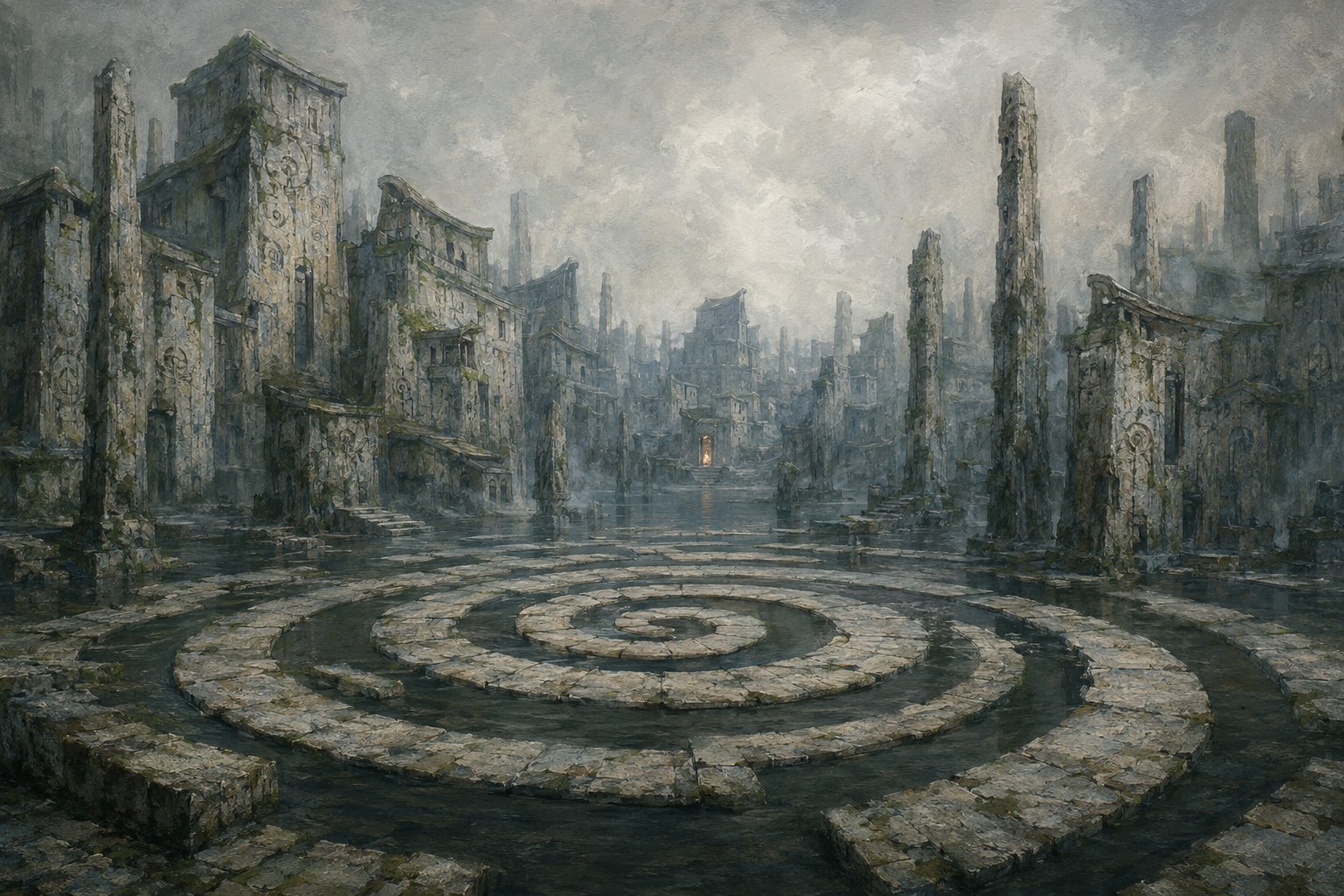
An alley opened to the left. Perfectly symmetrical. On the ground, a spiral of stone tiles. Familiar. Ancient.
The spiral curled toward the base of a towering structure — one that wasn’t quite a temple and not quite a machine.
Anoma whispered:
“This is where she stood.”
Lu glanced over. “Who?”
Anoma didn’t answer.
Instead, she pointed toward the base of the spiral. Embedded in the floor was a shallow recess — triangle-shaped, edged in faded carvings.
Something had once fit there.
Lu stepped closer. The scroll in his pack didn’t hum.
It listened.
Quietly attuning to the stone.
Takohito, who was still facing the other way, spoke casually.
“The scroll’s twitching. Like it heard its name spoken in the wrong tone.”
Lu nodded.
Takohito ran his fingers across the recess, tracing the worn triangle.
“Another one,” he said, almost to himself. “Same design. Older. This one’s been listening longer.”
Lu looked around at the city. The buildings. The un-decay. The silence that didn’t feel empty.
“So what broke it?” he asked.
“Not what,” Takohito said. “Who.”
Far above them, in a tower with no door, a wind chime rang once — though no wind stirred.
Inside the triangular recess, three faint dots shimmered.
Then vanished — as if embarrassed to be seen.
And somewhere nearby, hidden behind walls that had once been names, a breath was held.
Waiting.
VI
The spiral deepened.
What looked like a flat mosaic unfurled downward — not a staircase, but a basin carved in memory’s shape. Geometry as gravity.
At its centre: a slate of carved stone, faintly concave, like a bowl meant to catch breath instead of water. Whisper-shaped. Grief-smoothed.
Anoma crouched at the edge. Her fingers hovered just above the glyphs, but she didn’t touch them.
“She’s still here,” she whispered.
Takohito raised an eyebrow. “She?”
Anoma didn’t respond.
Lu stepped beside her. He saw nothing. Just faded inscriptions.
Then —
A breath. Not his.
The basin exhaled.
Glyphs shimmered faintly across the surface:
Δ
∴
⌘
And then something else. A shape that refused definition. A final glyph etched by silence itself.
Lu blinked. The last glyph flickered — then copied itself. The second mark spun outward, leaving a faint spiral trail like a forgotten thought trying to find its way back.
And then — a sound.
Not a voice. More like wind caught in a flute carved from someone’s name.
“Satra,” Takohito said gently, to no one.
The basin reacted.
From the curve of the spiral, a figure began to cohere — woven light shaped by echo. Not apparition. Not projection. Resonance pushed into form.
She stood barefoot on the innermost ring. Her robes shimmered like exhaled quartz. Her face unreadable — except for the eyes.
The eyes were listening.
“You brought the scroll,” she said, without looking.
Lu’s hand brushed the satchel unconsciously.
“You… know me?”
Satra’s gaze passed through him. Then back again.
“You’ve been here before. But you didn’t believe it that time.”
Takohito folded his arms.
“Satra. Not this time. We do not have long.”
“So is memory.”
She walked a slow, deliberate circle around the basin. One palm extended. Drawing breathlines only she could see.
Behind her, the glyphs began rearranging — triangulated strata. Δ nodes, ∴ maps, ⌘ overlays. They slotted into a glyphic lattice like a puzzle solving itself backwards.
Anoma stepped closer. Her lips parted — unsure why she suddenly felt like crying.
“You archived… emotions?” she asked.
Satra turned to her.
“No. I archived the breath right before they began.”
Takohito muttered, “…Of course you did.”
Satra smiled. Just a flicker.
“No. It’s resonance efficiency.”
Lu watched in silence. His heartbeat felt misplaced. Not racing. Misaligned. Like his body remembered something his mind still refused to.
Satra approached him again.
“The scroll carried one fingerprint,” she said. “Yours. Hidden in a fold you didn’t remember making.”
He pulled it from his satchel. His hands didn’t tremble. But the scroll did.
It unfurled slowly, as if responding to presence, not permission.
The glyphs on the page began quantizing — each symbol snapping into place with the basin in exact sequence:
Δ → ∴ → ⌘ → ???
“These aren’t just symbols,” Satra said. “They’re belief-locks. Conditions etched in thought. Gates that determine what reality lets through.”
“To what?” Lu asked.
Satra stepped back.
The basin pulsed with light. Soaked in something deeper than memory — not visions, but emotive fields.
A girl running down spiral stairs.
A name shouted from a high tower.
A voice — breaking in either joy or terror. Maybe both.
A child with Lu’s face. Laughing.
Anoma reaching toward him.
A shadow watching from behind the sun.
Then — silence.
Only one glyph remained: the one they couldn’t name.
???
“It remembers you,” Satra said. “But it’s not sure you’re ready.”
Anoma whispered, not to Satra but to herself:
“I think I’ve felt this place dream me before.”
Takohito knelt beside the basin, utterly still.
“We all are,” he said. “Just not at the same time.”
A breath echoed through the empty courtyard.
The glyph pulsed once — soft as a memory finally accepted.
Satra whispered: “Resonance confirmed.”
A pause. Then:
“Next node will not be so gentle.”

VII
The light from the basin dimmed.
Not faded — retracted. As if memory had blinked.
Lu stumbled back a step. The scroll in his hands went cold.
Takohito didn’t move. His eyes remained fixed on the place where Satra had stood — now just a hollow ring of low breath and evaporated light.
Anoma looked around.
The city was no longer still.
The glyphs on the walls were rearranging. Not slowly. Actively.
Scripts reversed mid-curve. Shapes flickered.
And the sky above —
Wasn’t the same colour.
Lu squinted. “Wasn’t it sunset a minute ago?”
Takohito raised an eyebrow. “Only from this timeline.”
“What?”
But then everything went quiet.
And then —
Static.
It wasn’t sound. It wasn’t light.
It was a skipped beat.
A doorway opened.
Not in the wall. Not in space.
In cause.
One of the houses folded.
Not collapsed — folded. Neatly. The way you fold a letter you have decided not to send.
Anoma gasped.
“That wasn’t supposed to happen.”
Takohito stepped forward, voice low.
“It’s trying to correct for contradiction. The node accepted your witness, but not your coherence.”
“What contradiction?” Lu asked.
Takohito turned to him slowly.
“You.”
A long silence.
The scroll twitched again.
Then — a noise. Like breath behind a closed door.
Not a door they could see.
Lu turned. “Did you hear that?”
Anoma didn’t answer.
She was looking at the sky.
Something had replaced the sun.
A shape. Large. Faint. Rotating slowly, as if behind a curtain of breath and belief.
Takohito went still.
“…Early. That is new.”
Lu stared. “What is that?”
“A Watcher,” Takohito said. “Not a being. A shape the Ledger wears when a breath moves faster than the older accounting expects.”
“So we tripped a safeguard?”
“Worse,” he said. “We reminded something it was supposed to forget.”
A low rumble passed through the city. Dust lifted in geometric spirals.
The scroll flared.
On its surface:
Δ → ∴ → ⌘ → ???
The last glyph pulsed. Then glitched.
One frame too long. One flicker too loud.
And for half a breath —
Lu vanished.
Anoma’s hand rose to where he had been, and held there, six inches from empty air.
Takohito didn’t move.
He watched the place where Lu had stood. Counted silently.
“One-oh-eight.”
Lu reappeared.
Collapsed to his knees. Breathing. Eyes wide.
But different.
As if he had just seen something his memory was already trying to erase.
Takohito crouched next to him.
“What did you see?”
Lu’s lips parted. A single word emerged.
“…Thass.”
He tried to file it. The drawer would not hold.
And the spiral on the stone began spinning again.
Not glowing.
Answering.
VIII
The sky moved.
Not fast. Not violently. Just enough to offend anyone with a working sense of up.
Lu was still on his knees.
Anoma knelt beside him. Not to speak. Just to be there.
Takohito watched them both. Then the sky. Then them again.
He did not, for once, have anything witty to say.
Lu’s breath steadied. Slowly. The word he had come back with — Thass — was still hanging in the air between the three of them, uncollected.
The ??? glyph hadn’t faded. But it had shifted — rotated slightly, pointing east.
Not pointing at something. More like —
“Projecting a direction,” Lu said aloud. His voice, when it came, was thinner than he expected.
Anoma helped him stand. Her hand hovered above the scroll, now inert. No more humming. No more alignment pulses.
Just stillness, with purpose.
“There’s a triangulation,” she whispered. “Look — between the basin, the tower above, and…”
She turned, and there it was.
A ridgeline of stone teeth beyond the city’s edge.
Impossible to notice before. Now — crackling faintly with glyphic static.
Lu stood on his own now. He looked at Takohito.
“The scroll’s moved.”
Takohito nodded. Once. No joke followed.
“That ridge holds the second harmonic,” he said. “We follow the projection.”
Anoma touched the edge of the basin one last time. The faintest shimmer rippled outward from her fingers.
It wasn’t light. It was memory.
And the glyph responded.
Not all of it. Just one dot from the triangle.
It drifted loose — hovering in air like a glowing bead of unsaid intention — and followed them.
The sky kept rotating.
The city said nothing.
But far away, a second node stirred.
息