I
The wind wasn’t cold.
It should have been — this high above the jungle line, past the last known trail, climbing a spine of slate so steep it felt like time itself had stopped to catch its breath.
But it wasn’t cold.
Instead, the air shimmered faintly, like heat mirage without heat.
And the path beneath their feet — dull grey stone braided with moss — coiled in a slow, perfect spiral. No switchbacks. No turns. Just one continuous loop, winding higher.
Lu stopped first.
“Did we pass this outcrop before?” he asked, pointing to a formation shaped like a crouching frog.
Takohito nodded. “Yes.”
“But we’ve been going up.“
Takohito smiled without humour. “So has the loop.”
Anoma didn’t speak. She walked with her hand brushing the spiral wall — left hand only, fingers trailing like memory anchors. Her eyes were unfocused, as if following something unseen just ahead.
His phone had, sometime in the last hour, stopped receiving. He did not check who he had been hoping would call.
The mist grew denser.
Soon they reached a set of worn stone steps that disappeared into a wide circular arch — a yawning gateway carved directly into the mountainside. Glyphs lined the arch, faded but still legible in a language none of them spoke and all of them felt.
At the very top of the arch, one glyph pulsed faintly.
♾
Not engraved. Breathed.
Like it had been exhaled by the stone itself.
Anoma’s hand lifted from the wall and hung, close but not touching.
Takohito stepped under the arch and stopped. “This is the monastery.”
Lu peered into the dim corridor beyond.
“I was expecting something more… solemn.”
Anoma frowned. “Something’s off.”
Takohito nodded. “Everything is.”
From within the passage, a soft melodic sound echoed — like water running backwards. Then, from the shadows, a voice drifted out.
“Ahhh. Visitors who do not belong.”

II
A figure emerged.
Old. Shaven head. Dressed in robes that looked grown, not sewn — woven from vines and script. His eyes were closed, yet he moved without hesitation. In his hand, a staff carved with looping patterns. Tucked beneath his other arm, almost like an afterthought, was a snapped flute — wrapped in a violet ribbon, its knot marked with a looping glyph.
“You’re the glyph-keeper?” Lu asked.
“I might be,” said the monk. “Or I was. I forget. The loop’s been running long.”
He tapped his staff once, and the floor beneath them shimmered — a spiral pattern revealing itself beneath the dust. The same as the one in the Lemurian basin.
Her hand rose and stopped short of the monk’s chest. “Have we… met before?” Anoma asked gently.
The monk turned toward her, eyes still shut.
“We meet everyone before they arrive. And we forget them the moment they leave.”
He tapped his chest.
“I am what guards the test. But not what gives it.”
Takohito raised an eyebrow. “And who gives it?”
The monk smiled, though it looked sad.
“The loop, of course.”
Behind him, the corridor deepened. No doors. Just another spiral — this time inward. Not ascending. Descending.
“Time to walk it,” Takohito said.
The monk stepped aside.
“Leave your certainties at the door,” he said softly. “And try to forget… gently.”
III
The corridor twisted inward like a thought folding in on itself.
No lanterns lined the path. No torch. No flame. And yet the walls shimmered — lit by memory, not light.
Somewhere ahead, deeper than footsteps could reach, a flute echoed once. Faint. As if breath had remembered music.
The spiral staircase ended without ending. Instead of another step, Lu’s foot landed on — sand.
Soft. Warm. Like beach after rain.
He looked up.
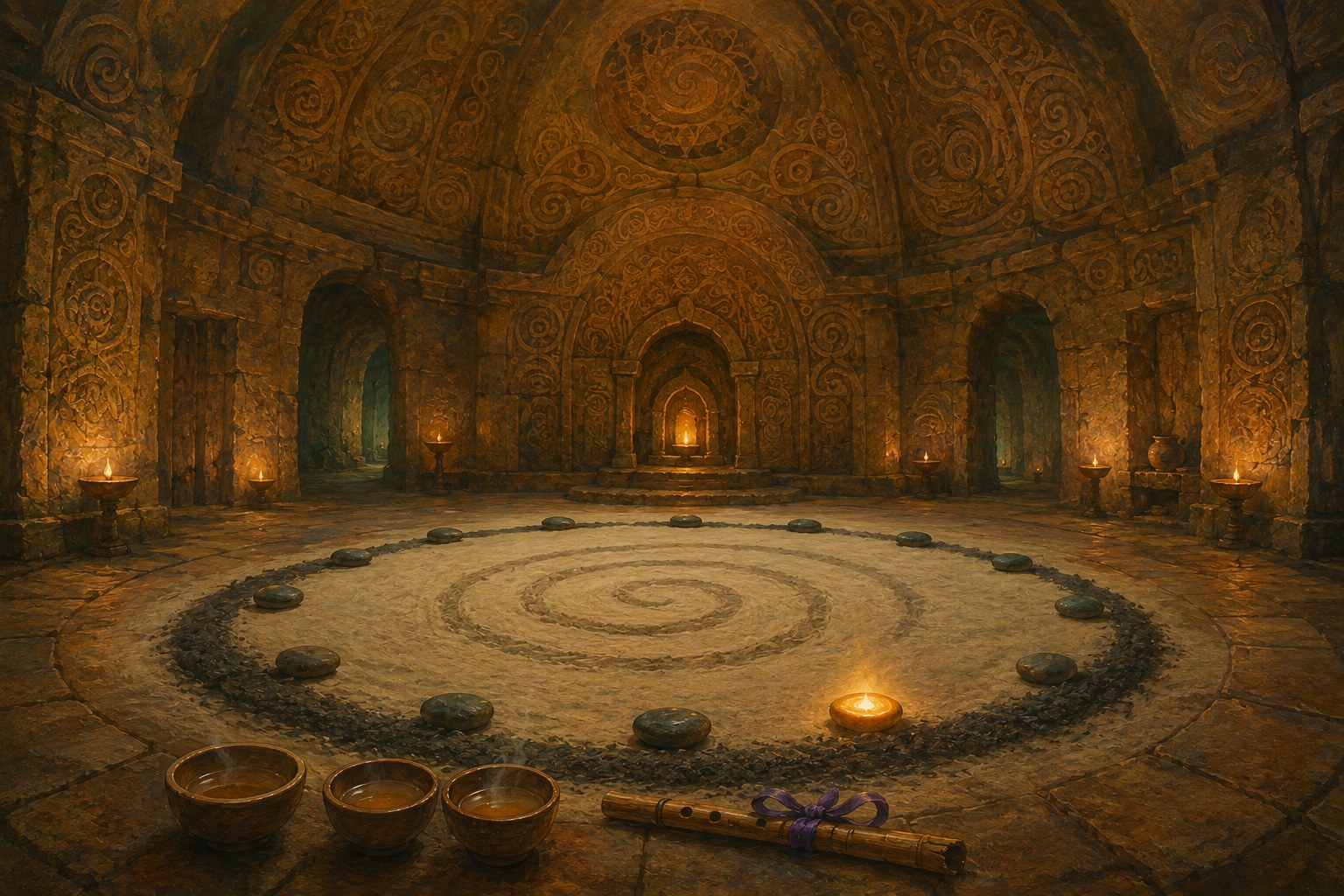
They stood inside a massive dome — carved into the mountain from within. Glyphs etched every surface in looping, recursive spirals. But none repeated. Not once.
In the centre stood the monk.
He hadn’t passed them. He’d never left. And yet — he was already waiting.
He sat cross-legged inside a sand circle. A loop of ash drawn around him. Twelve small stones lay at its edge.
One for each House.
Only one glowed faintly.
⧉ — House of Mirrors.
He raised his eyes without lifting his head. For a moment nobody moved. Then he gestured, once, at three wooden bowls set at the edge of the sand circle. Butter tea. Thick and slow, the specific taste of a monastery that had been serving the same recipe since the ninth century. Lu, who had not liked butter tea on his previous visit to Bhutan, drank his politely. Anoma drank hers gratefully. Takohito drank his the way a man drinks a memory he had not expected to be offered again.
“You remember me,” Anoma said slowly.
“I remember everyone,” the monk replied. “But only after I forget them.”
She didn’t answer right away. Didn’t need to.
The silence between them shimmered like heat on glass — visible only when you tried not to look. The glowing glyph — ⧉ — dimmed slightly at her hesitation. Reflected. Refracted. Reduced.
Anoma stepped to the edge of the sand loop. She knelt. Not out of reverence. Out of recognition. Her hand rose and stopped short of the nearest stone.
“You forget gently,” she whispered.
The monk’s head tilted — ever so slightly.
And for a moment, she saw her reflection — not in his eyes, but in the flicker of a stone. It was her face. But she was younger. Or never born. Like a memory that predated its witness. One that didn’t belong to any House.
Just — a shard.
Waiting to be chosen again.
The monk gestured to the sand.
“This is where the test begins.”
Lu frowned. “What kind of test?”
The monk’s voice was almost kind.
“The kind where passing it means you don’t remember taking it.”
“And failing?” Takohito asked.
“You remember everything that was never yours.”
He reached for the flute resting beside him. It was broken — cleanly snapped, then carefully knotted together with a ribbon that bore the loop glyph ♾.
Anoma crouched beside it. “Was that yours?”
“It was mine,” the monk said. “Until I tried to play what I couldn’t forget.”
He didn’t explain. He didn’t need to.
Behind him, the glyphs on the wall began to shift. The spiral map from the scroll emerged — Δ → ∴ → ⌘ → ??? — but this time, a fifth glyph pulsed at the centre.
∞
Not static. It trembled between forms, as if echoing all the others at once.
Not a glyph.
A synthesis.
The monk looked directly at Lu, for the first time. His eyes still closed.
“The loop doesn’t judge,” he said. “It reflects. And sometimes, it forgives by forgetting.”
Lu hesitated at the edge of the ash loop. His foot hovered — half instinct, half defiance — before trust overrode doubt.
He stepped forward.
The sand didn’t shift under his weight. It hummed.
A memory. Not his.
A woman placing a stone in a child’s hand.
“This is your loop. Don’t walk it too fast.”
A boy nodding.
A stone whispering: “Start over.”
Lu inhaled sharply.
The monk nodded.
“It’s begun.”
IV
The walls stopped glowing. Or rather — shifted frequency. They no longer lit the space.
They lit Lu.
The monk was silent. Not meditative. Not withholding.
He had become observational. Like someone awaiting a lunar eclipse. Or the return of a species no one had seen in three centuries.
Anoma stayed outside the circle. Takohito leaned on a carved recess by the archway, arms crossed, face unreadable.
Only Lu stepped forward.
The fifth glyph had appeared — ∞. It was not, in the strictest sense, drawn.
It was written in the specific weight of a decision Lu had not yet made.
He knelt.
At the centre of the spiral lay a single object.
Not a relic. Not a stone.
A mirror.
But it didn’t reflect Lu.
It reflected the child from the memory. The boy with the stone. The boy who had once laughed in a memory basin, when joy didn’t require justification.
And the boy said:
“You came back too soon.”
Lu opened his mouth. Paused. His body was here. His name was here.
But his reflection was one breath behind.
He reached toward the mirror.
The glyphs surrounding the circle flared.
Δ pulsed once.
∴ shimmered like a memory trying to resurface.
⌘ rotated — but refused to open.
∞ flickered — then doubled.
Two loops. Overlapping.
One loop of Lu. One loop — not of him.
Anoma gasped.
Takohito whispered: “It split.”
The monk stood now. He looked older. Or perhaps more recent. He walked to the edge of the circle and held up the broken flute. The same one they’d seen tucked under his arm — snapped clean, violet ribbon curled tight.
Anoma’s breath caught. She wasn’t surprised. But she wasn’t ready either. Her hand rose beside her, and stopped short of the flute.
For a flicker of a second, the silence around the flute reminded her of Satra. Not the shape. Not the glyph. But the hush. Identical. Like the breath before a truth speaks itself.
And suddenly, Anoma wasn’t sure whether she was remembering someone else’s grief or rehearsing her own.
The hush lingered like it wanted to become permanent.
Takohito sighed. Once.
He muttered, “Flutes again.”
No one answered.
The monk went on as if Takohito had not spoken. He had, Lu suspected, been ignoring Takohito for several centuries.
“Only one carries this forward. The one who remembers the sound. Or the one who holds the silence.”
Lu reached out.
The mirror dissolved.
And suddenly — he was holding the flute.
Unbroken. But not whole.
There was a breath inside it.
A breath he hadn’t taken.
He turned to Anoma. She didn’t say a word. Just nodded. Once.
He turned to Takohito.
“Which loop is mine?”
Takohito didn’t answer. He stepped into the circle. Drew a glyph in the sand with one toe. A spiral. A triangle. Three dots. A loop. But the last mark was new.
A handprint.
“Whichever version,” Takohito said. “The one that remembers you back is yours.”
And then the chamber began to rotate.
Not physically.
Something behind Lu’s eyes rearranged itself.
The glyph in the sand pulsed.
And then: silence.
The monk bowed.
A single spiral of dust rose around them.
V
The chamber dimmed as the last pulse of light retreated back into the glyphs.
Lu sat against the wall, drenched in his own breath. His hands trembled — not from exhaustion, but from recognition.
Takohito knelt nearby. Not beside Lu — beside the loop glyph, now hovering inches above the stone. Still there. Still pulsing like a breath caught mid-sentence.
Anoma crouched near the chamber’s edge.
“He wasn’t just syncing, was he?” she asked.
Takohito’s voice was quiet. “He tried to force consensus.”
“That’s bad?”
Takohito nodded, once. “He pulled data from a node that was still deciding if it existed.”
Lu’s head jerked up. “That wasn’t just a vision. I felt someone reaching for me.”
“They were,” Takohito replied. “But not to help.”
He stood. Behind him, the glyphs shimmered faintly — then reorganised into a spiral. Not a perfect loop, but one with an intentional break. Like a breath held too long.
“Earth’s rhythm isn’t stable any more,” he said. “Some parts remember things that never happened. Others are being overwritten in real time.”
Anoma turned. “What do we do.”
Takohito didn’t answer immediately.
He walked toward the centre of the room. The floor beneath him lit up — not from embedded tech, but from glyphs reacting to his presence. A trail of faint light looped behind his steps, forming a figure-eight.
♾
Then he did something unexpected.
He staggered.
Only a step — but in Takohito’s vocabulary, that was an earthquake.
Her hand rose and stopped short of his chest. “Something is going out of you.”
Takohito waved her off, but his smile was thin. “Fine. Just… delay. My link to the Ledger isn’t what it used to be.”
Lu stood slowly, watching him.
“You’re fading.”
Takohito didn’t deny it.
He filed the transparency. He filed how much it cost him to.
“I’ve been routing belief across fractured nodes for too long,” he said. “You can’t mediate a collapsing consensus forever without… leaking.”
A beat.
Anoma whispered: “Leaking?”
Takohito looked at her, then Lu.
“Ever see a memory wake up before you do? Or forget a face you never met?”
Lu nodded slowly.
“That’s not amnesia,” Takohito said. “That’s Ledger Bleed. One self drifting out of phase with the others.”
He closed his eyes. The glyphs around them rippled in silent sympathy.

VI
Then the chamber inhaled.
Walls blurred into sand. Ceiling shimmered into vapour. The air rippled — like memory when it remembers it’s being watched. Lu stood at the centre, flute in hand. Not playing.
Just listening.
The monk was gone. So was the door. Only the spiral remained — now elevated, etched into negative space. It hummed without sound.
Anoma looked at Takohito. Her lips parted. Then closed again.
“What’s happening to him?”
Takohito stepped forward, slowly. Pointed to the sand glyph beneath Lu’s feet.
It had shifted.
Δ → ∴ → ⌘ → ∞ → ⬚
A fifth glyph. But one that didn’t belong. An empty square.
No one spoke.
Then Lu raised the flute. Not to play it. To point it. Toward the empty square.
The chamber reacted instantly. The spiral inverted. The sand around the glyph turned to glass.
“He’s not choosing,” Takohito whispered. “He’s being recognised.“
“By what?” Anoma asked.
“By the thing that remembers you when you forget yourself.”
The square pulsed. ⬚
It filled with three dots. Then a triangle. Then a loop.
Then — nothing.
It erased itself.
And in that erasure, Lu’s knees buckled. He fell — but didn’t hit the ground. The chamber caught him. Not with force. With belief.
Anoma ran to his side. His eyes were open — but unfocused. He was seeing something that hadn’t happened yet.
Behind them, the glyph wall cracked. Not physically — emotionally.
A new path etched itself into the stone. Not stairs. Not corridor.
Just direction.
And at the end of it: a sound.
Distant. Echoing.
A child’s voice. Laughing. Calling Lu’s name.
But not his adult name. Not even his childhood name.
A name that only one person had ever used.
Anoma recognised it.
Her face twisted in something deeper than grief.
“That’s my sister’s voice,” she said.
The silence held. It had shape, and weight, and the specific density of a wound that has been carried a long time and, quite suddenly, been given permission to speak.
Anoma did not move. Her hand hung, six inches from the stone beside her, then settled onto it — flat, palm-down, the way a person steadies themselves when the ground has admitted, for the first time, that it can hear.
Lu, whose journalistic instincts had, over the past seventy-two hours, quietly retired, said nothing. He was, at that specific moment, a man remembering that some stories were not stories at all. They were people, waiting.
Takohito, quiet: “That’s the next node.”
Then, softer:
“That’s the cost of recognition.”
The chamber began to dissolve. Not collapse. Dissolve.
Consensus had been paid. The Ledger fulfilled.
All that remained — was what waited on the other side.
Takohito exhaled.
“I can’t hold this pathway much longer. If you’re going to the next node, you go now.”
Lu stepped forward. “And you?”
Takohito smiled. Almost kindly. “I’ll reroute. There are still paths only I can see.”
Anoma didn’t move. “You said that last time. You never told us what it cost.”
He met her gaze. No jokes. No riddles.
Just this:
“Don’t ask a map how it got lost.”
Then, with a single gesture, Takohito shifted the loop symbol — and the wall behind them folded open like parchment unwrinkling from fire.
A tunnel stretched ahead, impossibly lit, descending in a curve that bent both inward and downward — as if it was looping into itself.
The air smelled of salt.
And memory.
Takohito turned away.
“You have 108 heartbeats before this pathway collapses.”
Lu nodded. Anoma placed one hand on the wall, whispering something only it could hear.
Lu, who had spent eleven years learning that the story that finds you is the one you did not run, followed Anoma into the loop.
VII
The tunnel shimmered behind them — folding shut not with a slam, but with a sigh.
They walked in silence. No torches. No light. Only the memory of a glow.
Lu’s footsteps slowed. He lifted his hand.
And there, against the dark — something blinked.
Faint. But distinct.
On the centre of his palm:
♾
A loop. But not printed. Not tattooed.
Alive.
It pulsed once. Not with light. With something deeper. Recognition.
Anoma glanced over. Her lips parted, but didn’t speak.
From far behind — though no air carried it — Takohito’s voice reached them.
Calm. Distant. Fraying at the edges like an echo made of thought:
“We don’t earn glyphs by knowledge. We earn them by contradiction.”
The loop flickered again — then stabilised.
And Lu whispered, almost involuntarily: “I’ve been here before.”
A long silence. Her hand rose and stopped short of the glyph on his palm. Then Anoma replied: “No. But something that remembers you has.”
The spiral glyph on the wall behind them — half-dissolved into shadow — hummed once more.
Its sound was not a tone.
It was a recursion. A fold. A loop remembering its own beginning.
VIII. (Epilogue — The Witness Remains.)
Back in the chamber — the one the glyphs had reshaped into decision space — Takohito remained.
He hadn’t followed them. Not yet.
He knelt by the stone basin embedded in the floor, fingers hovering above the etched spiral. The faint light of consensus still pulsed beneath the stone — slower now, like a heartbeat too tired to commit.
He wasn’t in tune. He wasn’t guiding.
He was remembering.
And then — a flicker.
On the centre of his palm:
♾
The same glyph. But not the same loop.
It blinked. Once. Twice. Unstable. Uncertain. Not fading. But — shifting.
“The loop isn’t breaking,” he murmured to no one. “It’s changing its witness.”
He didn’t move. Didn’t look back.
But the basin did something strange.
It breathed.
And for the first time since Lu entered, it began reprojecting the spiral.
But now — there was a seventh node.
One that hadn’t been there before.
Its glyph?
⍰
A question not yet written.

Somewhere far to the south, an old man in a brown suit sat in a bath that was, at that precise moment, beginning to warm.
Somewhere in the north, three travellers had begun descending a corridor that folded gently in on itself.
And in a chamber neither of them could see, the auditor of a broken breath knelt over a basin that had just been asked, without warning, to remember him too.
息