I.
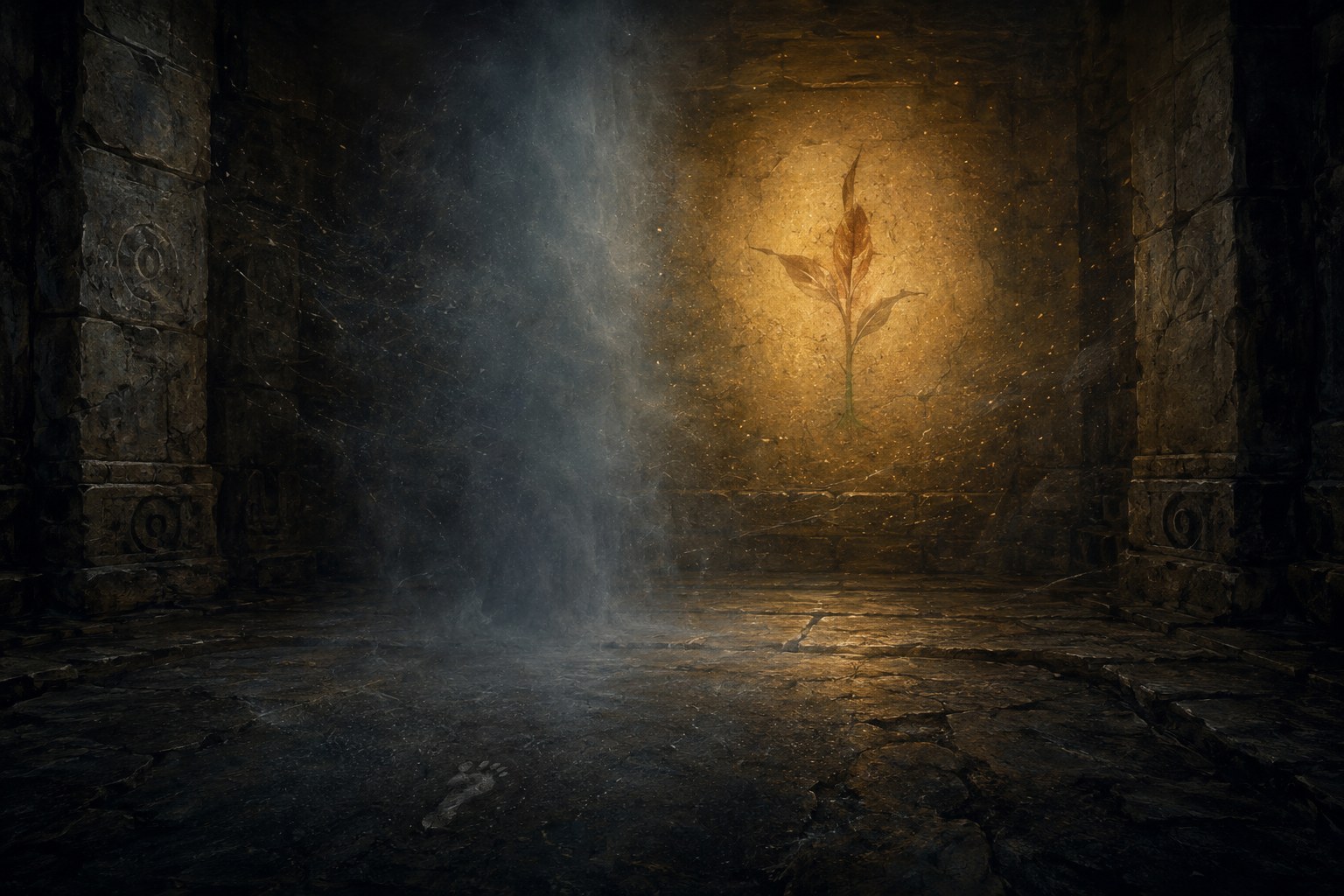
There are, in the Ledger’s professional vocabulary, sixteen distinct words for a room. There is not one for a room that has been, for the whole of a person’s adult life, refusing to release the air it took in on the afternoon of a specific temple fire.
The chamber, at four-eleven in the afternoon on the twenty-third of March in a year the corridor above it was no longer entirely in agreement with, was doing exactly that.
Anoma stood, in the specific composition of a person who was not standing so much as being held in place by the arrangement of the room, at the centre of the space between the slab and the wall. Her hand was at six inches from her sternum. It had not moved since the ascent, and had not moved on the descent, and had not moved in the pause on the third stair from the bottom while Xanthe, on the floor, had said the specific sentence about one confession.
The chamber breathed in.
It did not breathe out.
The dust on the slab, which had at the end of the previous hour begun moving very slightly toward the wall, was moving with a little more conviction. It was moving the way water moves in a room where somebody has, very quietly, opened a drain in the floor of a room adjacent. The wall, one hundred and eight metres away and forty-three years back, was drawing.
Xanthe, on the stone, said in the voice of a person who had run out of dye:
“Do not name it yet.”
Nobody had asked to name it.
Nakamori, at the bottom of the stairs, closed the notebook that he had already closed once and had not, in the intervening minutes, opened again. He held it against his ribs with the specific pressure that senior archivists use when they are trying to determine whether the vibration in their hands is entirely their own.
The vibration was not entirely his own.
He took from his inner coat pocket, at four minutes past three, a small paper package. Inside was a piece of feteer meshaltet, still faintly warm, wrapped in wax paper the specific colour of the corridor two floors above — a dried-tea brown Rima had, in all the years she had been feeding archivists, never once used a different shade of. She had pressed it on him with the words “You have not eaten, sir.” He put it back into the pocket. He would eat it later, if there was a later.
Anoma looked, without turning her head, at the slab.
The footprint under it — the eleven-year-old’s footprint that had, on the afternoon of the twenty-third of March in a year now called nineteen eighty-three, appeared in the dust here and nowhere else — was still there. The dust drifting slowly toward the wall was drifting around the edges of it. It was not willing to erase the print.
The wall was drawing air.
The print was staying.
Anoma, in the specific still centre of her body from which she had spent eighteen years reading glyphs before they were written, understood in advance of understanding that the room she was standing in was not a room.
The room she was standing in was the shape of a held breath.
She did not, yet, know whose.
She did not know why she had known, since the age of eleven, exactly how far to stand from the living.
The wall was drawing.
The wall had, on its far side, half a green glyph left.
The Seeds mark, which Xanthe had painted at the age of thirty-three in fresh soft green dye that had, until this afternoon, been the live-status marker for this whole Node, was brown from base to two-thirds of its height. What was left of the green was leaning very slightly toward the brown, in the specific way a plant leans toward the direction the light has just left.
Xanthe, on the floor, said, “Not yet.”
Nobody had moved.
II.
The temperature in the chamber dropped by seven degrees in the space of one breath.
The breath was Anoma’s, but she had not, in the specific composition of the moment, felt herself taking it.
Nakamori’s notebook, against his ribs, went cold.
The mirrors along the west wall of the chamber — the six copper-backed mirrors that House X’s cousins had, in the seventh century, installed here at the request of an office the Byzantine correspondence of the period had rendered stone-that-watches, for a reason the current administration had lost the paperwork for — went, without warning, one heartbeat behind.
It was, on close examination, only one heartbeat. Nakamori, who had been an archivist for forty-one years, watched his own hand not-quite-catch-up with itself in the copper on his left. The delay was not, in any commercially significant sense, large. It was one measure of the ambient pulse of the chamber. It was, in the specific administrative sense that archivists use, non-negotiable.
The mirrors kept mirroring, at their new tempo, without alarm.
Nakamori’s notebook, without his lifting a pen, wrote one line.
The line was: Chamber has begun to run late. Please do not attempt to correct.
Nakamori did not, at the writing of the line, look down at the notebook. He had been, in forty-one years of practice, on entirely companionable terms with the notebook on the subject of what did and did not require his attention. The notebook was, on this specific afternoon, being kind.
The glass in the small lamp at the base of the stairs began, in the same second, to hum.
The hum was, on a piano, an A-flat. On the Ledger’s frequency scale, which had, in a moment of nineteenth-century administrative theatre, been calibrated in Vienna against the tuning fork of the imperial court’s second oboe, it was one hundred and eight cycles per second.
It was not a tone.
It was a room getting ready to admit somebody.
Anoma’s hand had not moved from where it had been.
Xanthe said, without turning her head:
“He’s here.”
The chamber did not, in reply, produce a body.
It produced a colder patch of air.
The colder patch was, on inspection, standing on the stone between the base of the stairs and the slab. It was tall. It did not have edges. It did not have, in the specific way that the light in the chamber understood, a place for the light to stop. The light passed through the place it was and came out fractionally less bright on the other side. The reduction was, in engineering terms, well within tolerance. In every other terms, it was the specific gap in the room that Anoma had spent her whole life quietly declining to look directly at.
Anoma looked at it now.
The colder patch, in the manner of a very well-mannered guest, did not look back.
At the top of the three hundred and eight stairs, Rima said the specific second sentence she had rehearsed her whole career and had, until this afternoon, never had to say.
“He is escorted.”
Nakamori, at the bottom of the stairs, produced from an inside pocket a small envelope of black paper which he did not open. He held it, closed, against the base of his sternum. The envelope was of the design that Ledger archivists carried on their persons, without discussing, for the specific circumstance of a hostile presence entering a room that was, on paper, not currently rated for hostile presences.
The envelope did not need to be opened.
It was, in Nakamori’s professional judgement, a procedural comfort.
At the top of the stairs behind Rima, a second set of footsteps started slowly down.
The footsteps were Lu’s.
He had, in the seventeen minutes since Takohito had left the guest cell, done three things. He had opened the drawer in his mind marked LATER. He had, in the specific way of a man who had spent thirty years filing things he could not name, added one new heading to it — Things my Auditor is not, this afternoon, ready to say — and closed it. He had then, without asking anyone, walked to the top of the three hundred and eight stairs, because a corridor in the Parlour had produced, at approximately the moment the temperature dropped in the chamber, the exact specific inaudible sound that his wife had produced from the kitchen on the morning she had realised she was leaving.
The sound had been, in both cases, the sound of a room getting quiet before a person left it.
Lu came down the stairs, one at a time, on the outside of his heels.
He arrived at the base of the stairs at the moment the mirrors on the west wall settled — visibly, this time — a full second behind him.
He did not, on arriving, say anything.
He looked at Nakamori’s envelope.
He looked at Xanthe’s Seeds glyph on the wall.
He looked at the colder patch of air.
He filed, on the inside of the drawer he had just opened, the specific fact that his heart, which had for six months been performing a function he had internally categorised under Continuing Slowly To Believe In Things, had, on arriving at the base of the stairs, begun to perform that function at a tempo one heartbeat slower than the room he was standing in.
He filed this without alarm.
He did not, on the surface of his face, look at Anoma.
She did not, on the surface of her face, look at him.
They had, in the ninety minutes since the reading room, already looked.
III.
The colder patch of air said:
You were marked. Surrender the mark. The Ledger balances.
The sentence did not travel through the air of the chamber.
It arrived, in Lu’s inner ear, at the exact same moment Nakamori later reported it had arrived in his. Xanthe, who was closer to it than anybody else, later confirmed it had arrived in hers a small fraction earlier than in the others, and had, in doing so, briefly gone the wrong colour.
Anoma did not, at any point in the recording, hear it.
Anoma was listening to something else.
Lu, on the base of the stairs, felt the ♾ palm-glyph on his left hand go — in sequence, the way a badly-installed switch goes — cold, then hot, then cold again. The transition to hot was, for the first time in his six months of carrying the glyph, accompanied by an ache in the small bone below his thumb. The ache was, in ordinary orthopaedic terms, negligible. In every other terms, it was the specific ache of a mark trying to leave the hand it was currently on.
The mark was not succeeding.
The mark was resisting.
Lu, who had spent eleven years learning not to let the sentences he had just heard organise the sentences he was about to say, said, without raising his voice:
“I don’t know what a mark is.”
The colder patch of air, in the specific patient manner of a customer service representative talking to an account holder who had failed to log in three times in a row, produced a second sentence.
You were marked in twenty-eighteen. On the fourteenth of November. In the alley behind the Star Ferry terminal. You were carrying a notebook. You were told the mark was a keychain. You were correct. It was, additionally, a mark.
Lu, in the specific composition of a man who had, on the fourteenth of November, been carrying a notebook in the alley behind the Star Ferry terminal, and had subsequently spent nine years finding excuses to walk past that terminal at odd hours without opening the notebook again, filed the second sentence without adopting the vocabulary of the first.
He did not say mark.
He said, in the register that had, over the whole of his professional life, kept him from becoming the story: “What does surrendering look like.”
A choice. Yours. Voluntary. The Ledger balances. The alternative is that the Ledger balances anyway.
Lu, on the base of the stairs, opened the drawer in his mind labelled LATER, this time in the specific quiet manner of a man doing a stocktake. There were four unfinished stories in it. One of them was on the fourteenth of November in twenty-eighteen. It had, over the last nine years, migrated closer to the top of the drawer at a rate he had, on average, been able to ignore.
He did not take it out.
He looked at Anoma.
Anoma was not looking at any of them.
Anoma was looking at the wall.
Something in the small bones of Lu’s left palm, which had, on the transition from cold to hot to cold, been quietly declining to leave his hand, began to tilt.
The tilt was not toward Anoma.
The tilt was toward the wall.
Lu, without moving his hand, said the specific sentence he had, in eleven years of not adopting vocabulary that did not belong to him, refused as a matter of professional practice to say:
“I would prefer not to.”
The colder patch of air said nothing for a period of approximately three seconds.
Then it said, with the tempo of a form that had been designed by a committee: Noted. The Ledger continues.
The tilt in Lu’s palm did not stop.
It also did not accelerate.
It continued, at a rate the ledger of Lu’s small bones was, for the moment, still willing to file under ongoing observation.
He kept his hand still.
He did not, on the surface of his face, look afraid.
He was, on the inside of the drawer he had just opened, quite specifically afraid.
He filed the fear, this time, under a new heading. The heading was: Things I am not going to translate for it.
IV.
Xanthe, on the floor of the chamber, said in the voice of somebody who had been keeping a specific piece of information behind a wall for four decades and had, at four-thirteen, decided to stop:
“I owe you the version.”
She was not, in the specific composition of the sentence, looking at anyone.
She was looking at the wall.
Her palms, on the stone, had gone the last of the way past dust into stone. Where her hands rested was, in the composition of the chamber, another small piece of the chamber. Her elbows had begun, in the last four minutes, to do something similar. There was, in the specific way a lamp goes out in a room, a light going out of her. Where the light left, the outline of Xanthe was still there — the same slim old figure in the same soft grey robe, in the same posture she had held since collapsing at the top of Chapter 8 — but the light behind the outline was passing to the floor.
The floor was accepting it.
The floor did not have a use for it.
The floor was, in the specific administrative sense, doing what it had, in every other year of its existence, done — being the floor.
Xanthe said, into the wall:
“Nineteen eighty-three. In a monastery on a Gujarat coastline that had been on our register for eleven centuries. An eleven-year-old was, on the twenty-third of March, brought to a specific room by her sister.”
She paused, in the way a person pauses when they are gauging whether the room they are speaking into is going to be able to hold what they are about to put in it.
The room was still holding.
“The eleven-year-old had been,” Xanthe said, “for approximately seventy-one days, in a slow condition we — House X — have never had a good word for. She was, in the technical sense, becoming. She was not, at the point at which her sister brought her to the room, becoming toward anything the register had a form for.”
Nakamori, without lifting the notebook away from his ribs, held it a little tighter.
“There was, on the coast that afternoon, an offer,” Xanthe said. “Somebody on the outside of the register — I cannot, on this floor, name him — had, over the previous eighteen months, put a specific version of a specific weapon into the world. It was not, in the surface administrative sense, a weapon. It was a shape a person could accept. It was, on the surface, a mercy. On the underside, it was a substitution. Where a person was becoming, the shape substituted the direction of the becoming, and returned to the person the appearance of continuity.”
She paused again.
“The eleven-year-old was accepted for the offer, on the morning of the twenty-third of March, by a member of the monastery’s small council of trustees, without the knowledge of either the eleven-year-old, the eleven-year-old’s family, or the House.”
Xanthe did not, in the specific composition of the next sentence, close her eyes.
“When we noticed,” she said, “there were four minutes on the clock.”
The colder patch of air, on the stone, did not interject.
“House X,” Xanthe said, “does not, in ordinary practice, intercept a dying that has been agreed to.”
She paused for the third time.
“On this occasion,” she said, “we did.”
The wall drew in a small, quiet amount of air.
“We did not,” Xanthe said, “have four minutes. We had, in the specific sense that a person on a coastline in nineteen eighty-three has time, one minute and eleven seconds. In one minute and eleven seconds, three of us intercepted the shape that had been accepted for her, before the shape completed the substitution. The intercept had a cost we had, in eleven centuries of quiet practice, developed a specific tool for containing. The tool was this room.”
She did not say Node.
She said, “this room.”
“We took,” Xanthe said, “the last breath the eleven-year-old had drawn as her own — the specific breath she had drawn on entering the room, before the shape reached her — and we laid it against this wall. We laid it against this wall the way you would lay a candle against a paper lantern in a specific ceremony no living member of the House now performs.”
She looked, for the first time in the confession, at Anoma.
Anoma had not moved her hand.
“The candle stayed lit,” Xanthe said. “The lantern did not go up. The room, on the twenty-fourth of March, had a different shape than it had had on the twenty-second.”
The wall, in the chamber, drew again.
The Seeds glyph was brown to three-quarters of its height.
“The eleven-year-old,” Xanthe said, “did not, in the register’s ordinary bookkeeping, survive the intercept. The body of the eleven-year-old did not, in the ordinary orthopaedic sense, leave the room the intercept had happened in.”
She looked, this time, at the wall.
“The breath,” she said, “did.”
Nakamori’s envelope, against his sternum, went a fraction colder.
Anoma, in the still centre of her body, did not shift her feet.
“The breath is here,” Xanthe said. “It is still being held. It is what — for the whole of the intervening forty-three years — this room has been. A held breath, sustained, on the terms of an intercept the register does not, in its ordinary self-administered vocabulary, entirely approve of.”
She paused, and did the smallest possible thing with her mouth that was, in the specific practice of Xanthe, an apology.
“The breath,” she said, “was your sister’s.”
The chamber did not make a sound.
Neither did Anoma.
V.
Anoma, who had spent forty-three years measuring the exact distance between the living and the listening, did the following, in the following order.
She did not, in the first instance, look at Xanthe.
She looked, instead, at the slab. She looked at the eleven-year-old’s footprint under the drift of dust that was still moving slowly toward the wall around the edges of the print. She looked at the print, and at the spiral inside the triangle that had been carved that morning into the surface of the slab beside the print. She looked at the specific line the outer triangle had been drawn along, and at the specific arc of the inner spiral, and at the specific number of turns — three complete turns and a fourth turn that ended without completing — the spiral had inside the triangle.
She looked at these things in a manner that was, on the surface, unhurried.
Beneath the surface, the manner was the manner of a person who had, for the whole of forty-three years, been sitting a specific arm’s length from a specific piece of furniture in a specific room, and had understood for the first time on this afternoon that the arm’s length she had been sitting at was not, in the ordinary sense, a distance. It was a shape. And the shape was one she had, without knowing it, been holding on the inside of her own body.
She looked, then, at her hand.
Her hand was, at six inches from her sternum, in the exact place it had been, at every measured moment across forty-three years, in the presence of anyone or anything Anoma had been afraid — the word came slowly, from a place inside her that had not, in forty-three years, opened — of loving.
She had been, she understood in advance of the sentence, holding her hand at exactly the distance her sister had been standing when the fire fell.
She had not, in forty-three years, known this.
She had, in forty-three years, only kept the distance.
Anoma took, at four-sixteen and thirty seconds, in the specific quiet composition of a person who had run out of reasons to keep doing the thing she had been doing, one small breath in.
She let the breath out.
Her hand did not move on the exhale.
Then, in the specific slow manner in which a translator sets down a pen at the end of a document she has finished translating, Anoma turned on the ball of her left foot.
She walked across the bare stone of the chamber in her bare feet.
She walked past the slab. She walked past Nakamori. She walked past the colder patch of air, which did not, in the manner of a well-mannered guest, follow her with anything the eye of the room could name. She walked past Xanthe, whose light had, by the moment Anoma passed her, gone entirely to the floor, so that what remained of Xanthe was the outline in the grey robe and the specific set of the mouth that had, in eleven centuries of practice, learned to look at what she had just said and not correct it.
Anoma walked to the wall.
She stopped at the exact place where the Seeds glyph 🌱, brown now to the top of its stem, was going the last of the way out.
She raised her hand.
She held it, at six inches, against the wall.
Anoma, who had spent forty-three years measuring the exact distance between the living and the listening, dropped her hand for the first time and let it rest, palm-flat, against the wall where her sister had learned to hum.
The mark she had never known she carried surfaced, at the same moment, on her forehead.
It was a spiral inside a triangle.
It was the shape she had knelt beside in the dust, four hours earlier, without recognising it.
The surface of the mark was a specific charcoal grey — the same grey as the pouch on her hip.
It did not glow.
It only appeared.
Anoma said, in a voice that was not, in the specific composition of it, addressed to anyone in the chamber:
“That was my sister.”
She did not say it as a question.
VI.
The wall, on the far side of Anoma’s palm, produced a sound.
The sound was not, in the ordinary acoustic sense, coming through the stone.
The sound was, on close description, five notes.
The notes were in a mode the eastern practitioners of the Ledger, in the seventh century, had called the mode of the child who has been told the story is about to end and has not yet stopped believing it isn’t. The mode had, in ordinary Western terminology, no exact equivalent. It was, at the tempo the wall was producing them at, an Aeolian phrase with the fourth note held back a fraction of a beat, and the fifth note landing not on a resolution but on the specific space where a resolution would be if the phrase were, in future, to be completed.
The phrase did not resolve.
The phrase started again.
Lu, at the base of the stairs, went very still.
He had heard the phrase before.
He had, at three-eighteen in the morning on the twenty-sixth of April in the year now called the year of the Basin, heard it in a Bangkok stairwell where a small stone basin had, without being touched, produced a five-note melody, and had then produced the same five-note melody again, and again, and again, at the exact tempo the stairwell had been getting quieter at. He had, at the time, filed the phrase under a heading he had not gone back to.
The heading was: Things I do not yet have a category for.
He looked at Anoma.
Anoma’s hand was on the wall.
The mark was on her forehead.
The phrase, from the far side of the stone, played the fourth note late again.
Anoma, in the specific still composition of her body, opened her mouth.
She hummed, in the room the chamber had gone entirely quiet in, the exact same phrase.
Her humming did not, in the ordinary sense, harmonise with the wall’s humming.
Her humming did not, in the ordinary sense, need to.
The two phrases were the same phrase. The wall’s phrase was, on close audit, forty-three years old. Anoma’s phrase was, on close audit, of the same age. They had, on some specific afternoon in a monastery on a Gujarat coastline on the twenty-second of March in a year now called nineteen eighty-three, been learned together, by two children, in the same room. Anoma had, in the intervening forty-three years, not once produced the phrase in the presence of a witness.
She had, in the intervening forty-three years, produced it in her sleep on an average of one hundred and eight nights a year.
She had never been able, on waking, to remember what it had sounded like.
She could, at four-eighteen, remember.
The chamber, in the small quiet composition of a room that had, at last, been given permission to include the thing it had been holding out of its own hearing, did not applaud, did not warm, did not fall silent.
It kept the two hums going.
For twenty-nine seconds.
For twenty-nine seconds it was, in the specific composition of a room, a room in which two sisters were humming to each other across the specific membrane of a wall that had been keeping them, on the terms of an intercept the House had never entirely approved of, in each other’s near vicinity for the whole of their unequally allocated lives.
Xanthe, on the floor, did not correct the phrase.
Nakamori, at the bottom of the stairs, made a mark in his notebook.
He did not produce a follow-up entry.
The colder patch of air, on the stone, did not, in this moment, interject.
The colder patch of air did, however, at four-eighteen and thirty seconds, begin to lean in the direction of the phrase.
VII.
The lean was not, in the ordinary physical sense, movement.
The lean was, in the specific way a piece of paper leans toward a magnet the paper is not touching but the magnet is close to, an intention.
The intention was, in the Ledger’s professional vocabulary, a Substitution.
Xanthe, on the floor, in the last of her voice, said:
“He is going to try to receive her.”
Lu, without moving from the base of the stairs, said the second specific sentence he had, in his professional life, refused as a matter of practice to say. He said it in the same register in which he had said I would prefer not to, and with a small additional degree of composure that had, in the intervening seven minutes, come to him from the specific inside of the drawer in his mind marked LATER:
“That is not what she is.”
The colder patch of air did not address Lu.
It addressed, in the exact frequency at which the mirrors on the west wall were still running one heartbeat behind the room, the wall.
The address was, on the wall’s side, felt.
The five-note phrase from the far side of the stone hesitated at the fourth note.
The phrase did not produce the fifth.
Anoma’s hum, on the near side of the wall, kept going for a further half-beat, and then, at the small quiet moment of the missing fifth note, stopped.
Her palm did not leave the wall.
The mark on her forehead did not go out.
The colder patch of air, in the specific composition of a form that has been designed by a committee to produce a specific administrative outcome by a specific administrative date, laid an intention against the wall.
The intention was: Surrender here.
The wall began — in the specific slow manner of a lantern going, in a wind, sideways — to lean toward the intention.
Xanthe, on the floor, said, in what turned out to be the last complete sentence her voice was going to produce:
“I cannot — hold.”
The Seeds glyph 🌱 on the wall, brown to the top of its stem, went, in the same second, brown to the tip of its highest leaf.
The green did not exist anywhere on the wall.
The chamber shuddered, in the specific way a room shudders when a load-bearing element in a room adjacent has, in the manner of an old beam, decided to reconsider its commitments.
The dust on the slab, which had for the whole of the chapter been drifting slowly toward the wall, changed direction.
It began to drift toward the colder patch of air.
Anoma, at the wall, did not turn her head.
She said, without lifting her palm from the stone:
“No.”
She said it, in the specific composition of the syllable, with the exact same tempo the fourth note of the phrase had, thirty seconds earlier, been held back at.
The wall stopped leaning.
The lean stalled.
It did not resume.
It also did not go back the way it had come.
The chamber, in the specific composition of a room that has, in a year the corridor above it is no longer entirely in agreement with, been held very briefly in stasis by the palm of a woman on the near side of a wall — did not, in the following minute, produce a second breath.
It held.
Lu, at the base of the stairs, felt the tilt in the small bones of his left palm come to a stop.
The tilt did not reverse.
The ache did not go away.
He kept his hand still.
He filed, under the heading Things I am not going to translate for it, the observation that the room he was standing in had, at approximately the moment Anoma had said the syllable no, decided to postpone a decision it had, five minutes earlier, appeared to be in the process of making.
Nakamori, at the bottom of the stairs, in the specific composition of a professional who had, in forty-one years of practice, learned to conserve the last of a specific kind of resource for the specific occasion, opened the black envelope against his sternum.
He did not use its contents.
He only opened it.
VIII.
Somebody came down the last four stairs.
The somebody was, on the twenty-third of March in a year the corridor above the chamber was no longer entirely in agreement with, Takohito.
He came down the stairs slowly.
He came down on the outside of his heels, the way a man comes down a set of stairs he has, in a life it would be inaccurate to describe as ordinary, come down more than five hundred times.
At the second stair from the bottom, he stopped.
He looked, in the specific ordered manner of a man who had developed a personal etiquette for entering a room in which the room had been, until his arrival, holding something with somebody else’s help, at the four things he had come into the chamber to look at.
He looked at Xanthe.
He looked at Lu.
He looked at Anoma — first at her hand, on the wall, and then at the mark, on her forehead, and then, without moving anything on the surface of his face, at the specific length of time the mark had been visible.
The specific length of time was four minutes.
He filed the specific length of time in the ledger inside the Auditor’s inside pocket that no ordinary auditor kept a ledger in.
He looked at the wall.
The wall did not look back.
Takohito, on the second stair from the bottom, took his left hand out of the pocket of the dark robe he wore across the whole of his working life. He held the hand at his side. The ♾ palm-glyph on the palm of it — which had been, at the end of the previous afternoon, a slow visible crack from the outer edge of the loop, across the interior of the mark, and down toward the base of his thumb — had, at four-twenty-two, opened.
The crack was, on Takohito’s side of the room, bleeding light.
The light was gold.
The gold was slow — not the tempo of blood, not the tempo of leaking, but the specific tempo of an old boiler pressure gauge that had, on the twenty-second of March, still been within tolerance, and had, this afternoon, gone one small measure past the mark the gauge had, over the whole of eleven centuries, been trusted not to go past.
The light did not, on the stone of the chamber, drip.
It rose.
It rose in a thin slow line off the palm of Takohito’s left hand and dissipated at approximately the height of his shoulder.
He did not, in the specific composition of the moment, cover it.
He did not, in the specific composition of the moment, apologise for it.
He only stood, on the second stair from the bottom, with the light rising slowly off his palm, and looked at Anoma.
Anoma, at the wall, without turning her head, said:
“You came.”
Takohito closed his eyes.
The closing was, on the specific measured composition of Takohito’s closings, half a second exactly.
Then he opened them.
“I need to tell you something,” he said, in the voice of a man who had, forty years earlier, watched a continent go missing, “before we do this.”
The colder patch of air, on the stone, did not interject.
The mark on Anoma’s forehead did not go out.
The five-note phrase, on the far side of the wall, did not resume.
The chamber, in the specific composition of a room that had at four-eleven begun the afternoon by holding its breath for forty-three years and had at four-twenty-two arrived at the moment in the afternoon at which someone was about to try to persuade it to release the breath on his terms, waited.
Xanthe, on the floor, did not move.
Nakamori, at the bottom of the stairs, closed the envelope in his hand without using it.
Lu, at the base of the stairs, did not open the drawer marked LATER a second time.
Anoma, at the wall, in the specific composition of a woman who had walked into a room she had not, in forty-three years, known she was walking toward, said, without turning her head:
“Say it, then.”
The wall, at four-twenty-three, drew.