I.
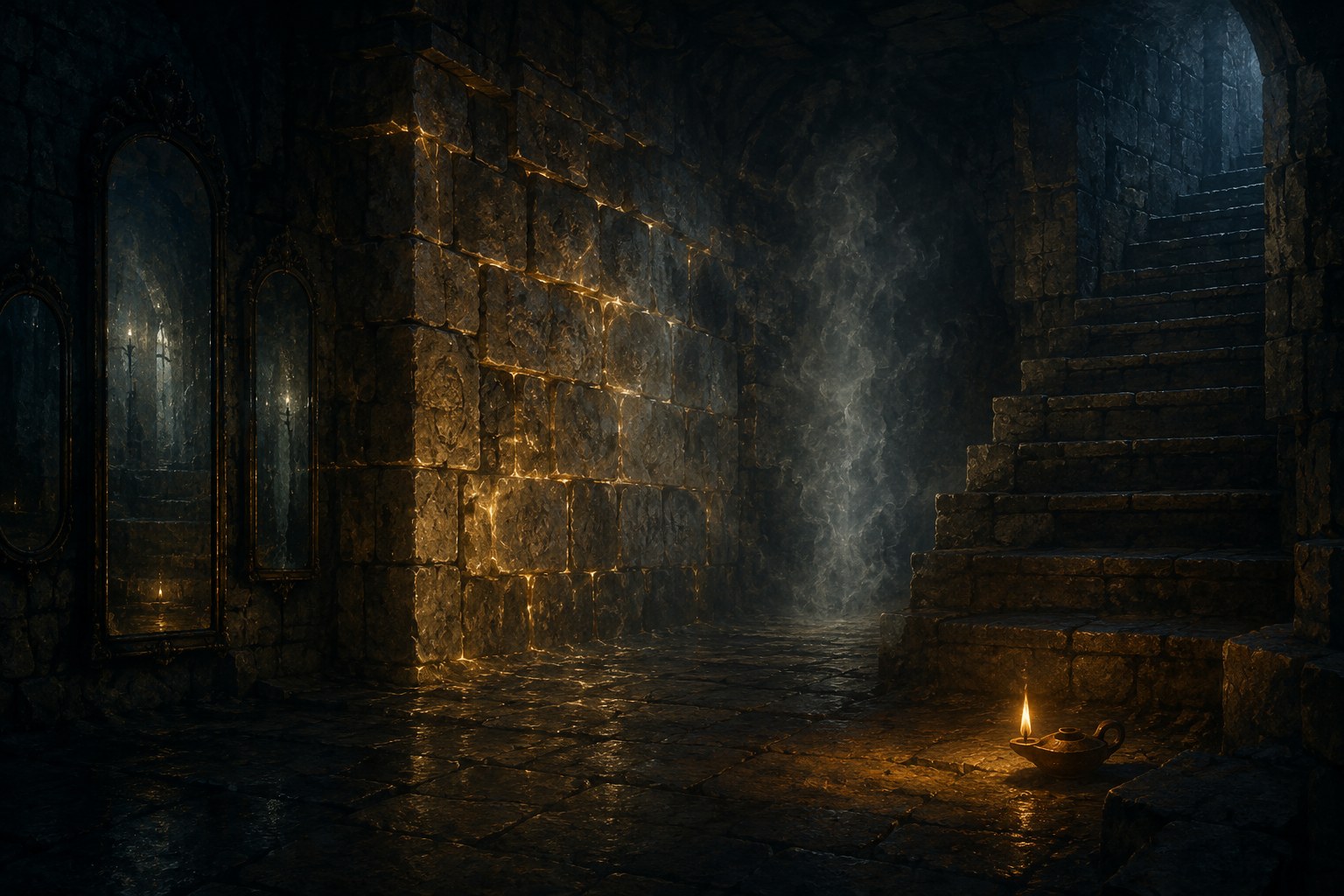
The chamber, at four-thirty-two and twenty-five seconds, was still.
The stillness was not the stillness of a room that has been given permission to rest. It was, in the specific administrative composition of a stillness that has been engineered by pressure at both ends, the stillness of a piano key that has been held down for exactly the length of time it takes a chord to complete.
The colder patch of air, on the stone between the base of the stairs and the slab, held its intention against the wall.
The wall did not, at four-thirty-two and twenty-five seconds, respond.
Ilyo, at the far end of the chamber, looked at the wall.
She looked at it in the specific composition of a healer of memories who had, in the last four minutes, been trained to look at a wall the way a doctor looks at a body which has, over the course of a long night, quietly finished the transformation the doctor had been waiting for.
The wall was not, at four-thirty-two and thirty seconds, a wall.
The wall was — in the specific composition of a piece of masonry that had spent forty-three years being maintained by a Breathkeeper whose body had, at last, arrived at the tempo of the aquifer she had been gardening — Xanthe.
Ilyo, without moving her lips, said, in the not-quite-voice of House II, one small sentence to nobody.
The sentence was: You made it.
The wall did not, in the strict acoustic sense, answer.
The wall, on the specific frequency at which the eastern practitioners of the Ledger measured the arrival of a Breathkeeper at the medium she had been walking toward, agreed.
Anoma, at the wall, felt it in her palm.
She felt it in the specific composition of a woman who had, for the last thirty-five minutes, been in continuous contact with the stone — palm-flat, six-inch tic ceased, mark on her forehead settled — and had, at four-thirty-two and thirty-two seconds, felt through the stone a shift in the composition of the stone.
The stone had, over the last four minutes, gone from being stone to being stone-that-was-also-a-woman.
The woman was Xanthe.
The woman was the aquifer.
The woman was the medium.
Anoma understood, in advance of the sentence, that the wall on which her palm now rested was, in the specific composition of a room that had at four-eleven begun the afternoon by holding its breath and had at four-thirty-two arrived at the moment its Breathkeeper had elected to become the room’s own body, no longer separate from what it had been holding.
Xanthe had, in the last three minutes, joined the sister on the other side of herself.
The countdown, in K0M-E’s voice from three days’ walk away through the Parlour link, said in the specific administrative silence that followed her earlier count:
“Ten.”
The count did not, at four-thirty-two and thirty-five seconds, insist on itself.
It only marked the second.
Takohito, at the centre of the chamber, looked at the wall.
He looked at the wall in the specific composition of an Auditor who had, four hundred years earlier, first learned the frequency signature of a Breathkeeper’s completed dissolution, and had, in every intervening century, filed it under a heading that had, on his own private administrative practice, never once been reopened.
He reopened it.
He filed the wall, at four-thirty-two and thirty-eight seconds, under the specific archival tag that House X Seeds used, without discussing, for the specific circumstance of a Breathkeeper who had completed the transfer.
The tag was: the medium.
He did not, at four-thirty-two and thirty-nine seconds, say the tag aloud.
He did not need to.
Nakamori, at the bottom of the stairs, held the envelope open against his sternum.
The envelope was, at four-thirty-two and forty seconds, containing blank paper.
The blank paper was of the specific design that Ledger archivists carried on their persons, without discussing, for the specific circumstance of an audit-record which was, on its arrival at the receiving surface, meant to write itself.
The paper began, at four-thirty-two and forty-one seconds, to write itself.
Nakamori did not read the first line as it appeared.
He held the envelope open, angled toward the chamber, and let the paper do the work.
The countdown said, into the corridor:
“Nine.”
II.
The colder patch of air, on the stone between the base of the stairs and the slab, laid its intention against the wall.
The intention was, at the specific tempo of a form-based operator arriving at the first item on its schedule, an attempt.
The attempt was: Substitute here.
It was, in the specific composition of a presence that had spent the last twenty minutes learning that the wall would not accept a straight overwrite, an adjusted attempt.
The adjustment was, on the visible surface of the colder patch, a ripple.
The ripple was, on close description, a shift in the specific way the light passed through the specific gap in the room where the colder patch was standing. The light had, since four-eleven, been coming out fractionally less bright on the other side of the gap. At four-thirty-two and forty-five seconds, the light on the other side of the gap took on, for a fraction of a second, the exact specific charcoal-grey the mark on Anoma’s forehead had, since four-seventeen, been.
The gap was, in the specific composition of a chromatophore, matching.
The gap held the appearance for approximately one second.
Then, because appearance-is-reality only works when the frequency underneath the appearance matches the frequency of the surface, the gap fell back to its earlier state.
The gap was, at four-thirty-two and forty-seven seconds, still tall, still without edges, still filtering the light.
The wall had not, at any point in the attempt, responded.
The wall had not, at any point in the attempt, been available for response.
The countdown said:
“Eight.”
Anoma, at the wall, without turning her head, without opening her eyes, without removing her palm from the stone, spoke.
She spoke in the specific composition of a translator who had, over the whole of eighteen years, been reading glyphs before they were written, and who had, at four-thirty-two and forty-eight seconds, elected to write, at last, the specific glyph she had been born carrying.
She said:
“The scroll.”
She did not raise her voice.
She did not need to.
The pouch at her hip, in the specific composition of a woven bag that had been carrying an unread scroll since E. Lemuria, opened without her lifting a hand to it.
The scroll unrolled itself in the air.
The scroll was — on the visible surface of it — a small phrase in a script the House X practitioners had, in the seventh century, called the specific alphabet of a breath that has been sustained without being spoken. The script was three glyphs long. It was, in ordinary translation, a form the Ledger did not, in its ordinary bookkeeping, have a heading for.
The three glyphs were: the sister’s breath · not yet released · held by consent.
Anoma said the three glyphs, one at a time, without raising her voice.
The wall, on the far side of her palm, at four-thirty-two and fifty-two seconds, did the small quiet thing a wall does when it is asked, for the first time in forty-three years, to acknowledge on its own record what it had been silently carrying.
The wall was, in the acknowledgement, still.
The scroll — having been read — did not, at four-thirty-two and fifty-four seconds, need to remain.
The scroll returned to the pouch.
The pouch closed.
The colder patch of air, on the stone, attempted, at four-thirty-two and fifty-five seconds, to receive the sister’s breath as a deposit.
The colder patch of air, at four-thirty-two and fifty-six seconds, found that there was nothing to receive.
The breath had never been released.
The breath was, in the specific administrative composition of a signature that had been held without being spent, still on the wall.
The wall was not, on this transaction, willing to make change.
The colder patch of air, on the visible surface of its intention, fell back a fraction of an inch from the stone.
The countdown said:
“Seven.”
III.
Something at the far end of the chamber, at four-thirty-two and fifty-eight seconds, stepped forward for the second time.
Itu.
He had, since Chapter Eight, been standing where nobody had looked. He had, since Chapter Eleven §VI, been visible. He had, in the intervening five minutes, remained still.
At four-thirty-two and fifty-nine seconds, he moved.
He did not, in the composition of the step, raise his voice.
He did not, in the composition of the step, produce a sound on the stone.
He was, at four-thirty-three exactly, standing one metre further into the chamber than he had been at four-thirty-two and fifty-eight.
The colder patch of air, on the stone, adjusted its intention.
The colder patch had, at some point in the last minute, without being seen to, read three lines of Nakamori’s blank paper.
The intention, this time, was an attempt at the second signature.
The second signature was silence.
The colder patch of air, on the visible surface of it, tried to match silence.
It did this, in the specific way a chromatophore-theology operator tries to match a colour that does not have a colour, by producing a fractional absence of sound on the west wall of the chamber. The mirrors on the west wall, which had for the last forty minutes been running one heartbeat behind the room, went, at four-thirty-three and one second, one heartbeat ahead of the room.
The reversal was, on the composition of the room, an attempt to look like the absence of a sound.
It was, in the specific sense that silence is silence and reversal is reversal, not silence.
Itu, at four-thirty-three and three seconds, spoke.
He spoke in the specific composition of a Breathkeeper who had been sealed three hundred and twenty-seven metres below a moai on the coast of Rapa Nui for eleven thousand years, and who had, at last, arrived at the specific chamber in which the sister he had been sealed alongside had, forty-three years earlier, been laid against a wall.
He said, in the voice of a man who had been listening for the length of a specific administrative interval:
“I have been listening for eleven thousand years.”
He paused, in the specific composition of a man who had, in eleven thousand years, developed a personal etiquette for the second sentence.
He said, “I am ready to stop.”
The chamber did not, at four-thirty-three and six seconds, receive the sentence in the ordinary sense.
The wall, on the far side of Anoma’s palm, received it.
The wall, on the specific composition of a Breathkeeper who had at four-thirty-two elected to become the medium, absorbed Itu’s eleven thousand years of silence at the tempo of the aquifer.
The silence was, on the administrative record Nakamori’s paper was quietly writing, added to the sister’s held breath.
The colder patch of air, on the stone, at four-thirty-three and seven seconds, fell back a further fraction of an inch.
The countdown said:
“Six.”
IV.
The colder patch of air, having elected to escalate the schedule, produced the third attempt.
It attempted, at four-thirty-three and eight seconds, to substitute for Takohito’s ♾ palm-glyph.
It did this, in the specific way a chromatophore-theology operator tries to be a specific person by being an accurate copy of that person’s operational surface, by producing, on the stone where the colder patch was standing, a small visible ♾ mark.
The mark was, on close description, correct.
The mark was, in the specific ways the ordinary Ledger bookkeeping measured, a valid ♾.
The mark was, on the visible surface of the colder patch, the correct golden colour.
Takohito, at the centre of the chamber, looked at the mark.
He did not, at four-thirty-three and ten seconds, close his eyes.
He said, in the voice of a man who had spent four hundred years auditing every ledger except his own, and had, at four-thirty-three, decided to enter his own:
“That is not what I am.”
He opened his left hand.
The ♾ palm-glyph on the palm was still cracked. The crack was still bleeding a slow gold light. The paradox glyph ⍰ underneath was still visible.
He held the hand out toward the colder patch, palm up, without hurrying.
He said, “This is what I am.”
The colder patch of air, on the stone, observed the palm.
The colder patch of air, in the specific composition of a form-based operator that had been engineered to categorise, tried to categorise.
The categorisation was, on the visible surface of the colder patch, unsuccessful.
The colder patch attempted, in the specific way a chromatophore-theology operator tries to hold two colours at once, to be both the accurate ♾ and the paradox ⍰ simultaneously. Its surface, at four-thirty-three and twelve seconds, rippled between the auditor-shape and the defect-shape at the tempo of a very fast strobe.
The strobe was, in the specific composition of a chromatophore that has been asked to be one thing while being another thing, an accounting error.
The colder patch of air, on the stone, did the small quiet visible thing a chromatophore does when it is failing.
It went, for a fraction of a second, transparent.
Then it snapped back.
The snap-back was not, on the composition of the colder patch, complete.
Something in the intention it was carrying, at four-thirty-three and fourteen seconds, had lost one small measure of the resolution it had earlier been able to maintain.
The countdown said:
“Five.”
Takohito closed his hand.
He did not, in the closing, cover either mark.
He said, without raising his voice, to the specific empty position at the base of the stairs where a man in an eleven-year-old raincoat had been standing for the whole of the chapter:
“You are on.”
V.
Lu, at the base of the stairs, had been standing very still.
He had, since four-thirty-two, been standing in the specific composition of a witness who had, at approximately the tempo of the countdown, arrived at the sentence he had, for eleven years, been declining to write.
He had not, at four-thirty-three and fifteen seconds, decided to write it.
He had, at four-thirty-three and sixteen seconds, decided instead to say the thing whose absence had, for eleven years, been the shape of the drawer.
The droplet on his left palm — the fourth droplet Ilyo had left him at four-twenty-eight and twenty-two seconds — flickered.
It did not fall.
It did the specific small thing a droplet does when the person it has been sitting on has, in the specific administrative sense, decided to keep it.
Lu opened the drawer in his mind marked LATER.
He opened it, this time, in the specific quiet manner of a man who had, in three hundred and eighty pages, learned that a drawer opened in a specific composition of professional practice was, in the end, the same drawer opened in a specific composition of ordinary domestic decision.
The drawer contained, at four-thirty-three and eighteen seconds, four unfinished stories.
Lu did not, at four-thirty-three and nineteen seconds, take any of them out.
He looked, instead, at the drawer itself.
He filed the drawer under a heading he had not, in eleven years, made a category for.
The heading was: Mine.
He closed the drawer.
He did not, in the closing, use force.
He closed it in the specific composition of a man who had, at last, understood that a drawer marked LATER was, on the composition of it, a drawer whose contents were his to write.
He walked from the base of the stairs to the centre of the chamber.
He walked past Nakamori. He walked past the colder patch of air. He walked past Xanthe’s outline on the floor — which was, at four-thirty-three and twenty seconds, no longer an outline, because Xanthe’s outline had gone the last of the way into the stone, and what remained of Xanthe was the wall.
He stopped, at four-thirty-three and twenty-one seconds, on the specific piece of stone directly to the left of Takohito.
He held up his left hand.
The ♾ palm-glyph on the palm was still there. The fourth droplet, in the small hollow where the bone joined the wrist, was still there.
He said, in the flattest voice he had ever produced:
“I am here.”
He paused, in the specific composition of a man who had been trained by eleven years of refusing to become the story to say what he was about to say without any of the composition of the story pressing itself into the sentence.
“I was not tagged.”
He paused, in the specific composition of a man who was, at the third sentence, offering the presence in the room the specific vocabulary it had, on the record of the last two afternoons, been assuming he did not have.
He said:
“You do not have a form for me.”
The chamber did not, at four-thirty-three and twenty-five seconds, receive the sentence.
The colder patch of air, on the stone, received the sentence.
The colder patch of air, in the specific composition of a form-based operator that had been engineered to categorise, tried to categorise Lu.
The categorisation was, on the visible surface of the colder patch, immediately unsuccessful.
The colder patch attempted, in the specific way a chromatophore-theology operator tries to match a colour that does not have a colour, to become the specific shape of an untagged human witness.
There was, in the vocabulary of the colder patch’s chromatophore, no colour that corresponded to untagged.
The colder patch, at four-thirty-three and twenty-seven seconds, held.
The hold was, on the composition of the colder patch, a hold not of success but of paralysis.
The droplet on Lu’s palm, at four-thirty-three and twenty-eight seconds, released.
It did not fall.
It rose, in a thin slow line off the palm of Lu’s left hand, and dissipated at approximately the height of his shoulder.
Anoma, at the wall, without turning her head, said:
“That was yours.”
Itu, at the centre of the chamber, without turning his head, said:
“That cost.”
Neither of them, in the composition of the sentences, added any further vocabulary.
Lu, at the centre of the chamber, did not translate the sentences.
He kept his hand still.
The countdown said:
“Four.”
VI.
Anoma, at the wall, moved her hand.
She did not remove it from the stone.
She pushed against it.
The push was, on the specific composition of Anoma’s palm, not physical.
The push was, in the specific way a person pushes against a membrane with intention rather than pressure, an invitation.
The invitation was to the wall.
The invitation was to Xanthe.
The wall — being Xanthe — accepted.
Anoma said, without turning her head, without opening her eyes:
“Sister. It is time.”
She did not name her.
She did not need to.
The phrase from the far side of the wall, which had at four-eighteen been humming the specific five-note Aeolian phrase, and had at four-nineteen and eleven seconds stopped at the missing fifth note, and had in the intervening fourteen minutes been waiting — began, at four-thirty-three and thirty seconds, the specific phrase again.
The phrase was at approximately one hundred and thirty-six cycles per second — the specific frequency of a person who was, at last, saying her own name.
The phrase started at the first note.
The phrase moved to the second note.
The phrase moved to the third note.
The phrase moved to the fourth note.
The fourth note, this time, was not held back.
The fourth note arrived on the beat.
The fifth note, this time, arrived on a resolution.
The resolution was, in the specific composition of an Aeolian phrase that had at last been permitted to complete itself, the small sound of a sentence that had, for forty-three years, been almost said, arriving at the specific place where it wanted to arrive.
The phrase, on the near side of the wall, travelled through Xanthe.
Xanthe was, at four-thirty-three and thirty-two seconds, stone.
Stone that had, over forty-three years, been maintained by a Breathkeeper of Seeds at exactly the aquifer-saturation the eastern practitioners of the Ledger had, in the seventh century, called the specific composition of masonry through which a completed breath travels at the tempo of the sea.
A completed breath, travelling through Xanthe, moved — on Nakamori’s blank paper as it wrote itself — approximately four thousand metres per second faster than the same breath would have moved through the corridor above the chamber.
The colder patch of air, on the stone, at four-thirty-three and thirty-three seconds, was operating at approximately three hundred and forty metres per second.
The phrase, travelling through Xanthe, arrived at the far side of the chamber at approximately five thousand metres per second.
The differential was, in the specific administrative composition of a race in which one runner was in air and the other was in water, unbridgeable.
The colder patch of air, on the stone, at four-thirty-three and thirty-four seconds, attempted to re-voice its one hundred and eight cycles per second counterfeit at the new tempo.
The colder patch of air, on the stone, at four-thirty-three and thirty-five seconds, could not.
The chamber, in the specific composition of a room that was, at four-thirty-three and thirty-six seconds, hearing two frequencies arrive at two different times, did the small quiet thing a chamber does when the ordinary bookkeeping has, at last, arrived at the sentence it had been trying to write.
The chamber said, without a voice, to the specific administrative body that Nakamori’s blank paper was, at four-thirty-three and thirty-seven seconds, writing to:
These are not the same number.
The paradox glyph ⍰ on Takohito’s palm, at four-thirty-three and thirty-eight seconds, absorbed the differential.
The absorption was, on the visible surface of Takohito’s palm, the specific small event in which a glyph that had been engineered for exactly this administrative outcome performed exactly the administrative outcome it had been engineered for.
The counterfeit, on the colder patch, at four-thirty-three and thirty-nine seconds, collapsed.
The countdown said:
“Three.”
VII.
The collapse was not, in the composition of it, loud.
The colder patch of air, on the stone between the base of the stairs and the slab, dissolved at the tempo of a lantern going, in a wind, out.
It did not go, in the composition of the going, quickly.
It went at the specific tempo of an Alexandria mandate that had, at approximately four-thirty-three and forty seconds on the twenty-third of March in a year the corridor above the chamber was no longer entirely in agreement with, been closed.
The presence that had carried the mandate was not killed.
The presence was, in the specific administrative sense, unassigned from Alexandria.
The scaffolding remained.
Somewhere, in the outer chambers that did not, on any known plan, have a name, the presence would re-form.
Not today.
Not this afternoon.
The chamber, at four-thirty-three and forty-two seconds, released.
The mirrors on the west wall, which had for the last forty-two minutes been running one heartbeat behind the room and had for the last one minute been running one heartbeat ahead, settled at four-thirty-three and forty-three seconds into the specific administrative composition of mirrors that were, at last, running at the tempo of the room.
The glass in the small lamp at the base of the stairs, which had for the last one hour been humming at one hundred and eight cycles per second, dropped to a fifth of its earlier volume, then to a tenth, then to nothing.
The lamp, at four-thirty-three and forty-five seconds, kept lighting.
It only, in the composition of it, decided to do so without humming.
The countdown said:
“Two.”
Takohito, at the centre of the chamber, opened his left hand.
The ♾ palm-glyph on the palm was, at four-thirty-three and forty-seven seconds, still cracked.
The crack was not, at four-thirty-three and forty-eight seconds, bleeding.
The gold light had, at approximately the tempo of the counterfeit collapse, stopped rising.
The gold was, in the specific composition of a glyph that had, at last, absorbed what it was going to absorb, folding back into the loop.
Takohito, at four-thirty-three and fifty seconds, watched his own palm the way a man watches a room he has been away from for forty-three years finally admit him back.
The paradox glyph ⍰ underneath the ♾, at four-thirty-three and fifty-two seconds, went out.
Not out.
Home.
It slid, in the specific composition of a safety valve which had at last performed the safety it had been engineered for, back under the ♾ where it had been sitting since Chapter One.
The ♾ closed.
The crack, at four-thirty-three and fifty-four seconds, was still visible.
It was, on close inspection, no longer bleeding.
It was, on close inspection, healing.
Anoma, at the wall, at four-thirty-three and fifty-five seconds, did the small quiet thing she had not, in forty-three years, done.
She let her hand rest.
The hand did not leave the stone.
The hand only, at four-thirty-three and fifty-six seconds, stopped pressing.
The palm was, in the specific composition of a hand that had for forty-three years been holding a specific arm’s length from any living thing it might have been afraid of loving, no longer holding.
It was, at four-thirty-three and fifty-seven seconds, resting.
Itu, at the centre of the chamber, opened his eyes.
He opened them at the specific tempo of a Breathkeeper who had, for eleven thousand years, kept his eyelids down as a matter of professional practice, and had, at last, elected to see.
He did not, in the opening, look at Anoma.
He did not, in the opening, look at Takohito.
He did not, in the opening, look at Lu.
He looked, first, at the wall.
The wall was, at four-thirty-three and fifty-nine seconds, still humming — no longer holding, no longer gardening, only being what it had become.
Itu, on seeing it, made the small quiet sound he had been keeping behind his eyelids for eleven thousand years.
Nobody in the chamber knew what the sound was.
Ilyo, at the far end of the chamber, filed it in the not-quite-voice of House II as: the first exhale of a Breathkeeper who has been holding the specific breath he was sealed with.
She did not, at four-thirty-four exactly, translate the filing.
Lu, at the centre of the chamber, at four-thirty-four and one second, closed his eyes for a specific length of time that was not, on the composition of Lu’s tells, an ordinary blink.
He closed them for the length of time a person closes their eyes when they have, at last, decided to write a story they have been not-writing for eleven years.
Lu, who had, for eleven years, filed unfinished stories in a drawer marked LATER, closed the drawer entirely. He was, at that specific moment, deciding to start writing the finished ones.
He opened his eyes.
He did not, at four-thirty-four and three seconds, take out the Muji notebook.
He did not, at four-thirty-four and four seconds, need to.
The notebook was, in the specific composition of a professional tool that had been with a specific man for eleven years, waiting.
The countdown said, from three days’ walk away:
“One.”
VIII.
The countdown did not, at four-thirty-four and five seconds, say the next number.
The countdown said, instead, in the specific administrative composition of a voice that had at last arrived at the sentence it had been walking eleven chapters toward:
“Ja ne, minna-san.”
The chamber, at four-thirty-four and six seconds, greeted it back.
Not with a voice.
With a specific silence Anoma’s sister — on the far side of the wall — did not, at four-thirty-four and seven seconds, decline to fill.
The sister filled it with the phrase.
The phrase, this time, did not stop.
The phrase, this time, did not need to.
The voice, from three days’ walk away, said, without hurrying:
“That was one hundred and eight.”
The voice said it in the specific tempo of a countdown that had, at last, arrived at the number it had been counting toward.
Ilyo, at the far end of the chamber, at four-thirty-four and ten seconds, looked at the specific place at the far end of the corridor where the small woman with the clipboard had, since four-thirty-two, been standing.
The specific place was, at four-thirty-four and eleven seconds, still occupied by the small woman.
The small woman was, at four-thirty-four and twelve seconds, smiling.
The smile was, on Ilyo’s audit, at the wrong angle.
Ilyo had, in the last two hours, seen exactly one wrong-angle smile before this one. It had been in Chapter Eleven §VIII. It had lived in the pause of the countdown. It had been small.
This one was not small.
This one was, on Ilyo’s audit, at the specific wrong angle a person smiles at when they have, at last, arrived at the piece of the schedule they had been walking toward, and had, at last, decided not to conceal that the schedule was hers to keep.
The wrong angle was not, on the composition of the smile, unhappy.
The wrong angle was not, on the composition of the smile, tired.
The wrong angle was, on the specific composition of a smile that had, over eleven chapters, been almost-flickering at exactly this angle without ever holding it, held.
Ilyo did not, at four-thirty-four and fifteen seconds, look away.
She did not, at four-thirty-four and sixteen seconds, tell the room.
She filed the smile, in the not-quite-voice of House II, under the specific heading that she had — over the last six chapters — been quietly maintaining for K0M-E without telling anybody.
The heading was: what she is when she is not being what she is being.
The Parlour link, at four-thirty-four and seventeen seconds, began to close.
The small woman, at the far end of the corridor, at four-thirty-four and eighteen seconds, did not lower the smile.
She adjusted her cosplay one further time.
The cosplay, in the specific composition of an outfit that the taxonomists had not, in nine hundred years, built a category for, was no longer courier, and was no longer maid, and was no longer any of the other configurations K0M-E had, in eleven chapters, appeared in.
It was, on Ilyo’s audit, a configuration Ilyo had not, in her personal practice, seen before.
Ilyo did not, at four-thirty-four and twenty seconds, name it.
The corridor closed.
The corridor closed at the specific tempo of a door that had been opened for a specific administrative purpose, was closing on the completion of that purpose, and had, in the composition of the closing, no intention of being opened again by anyone in the chamber.
The chamber, at four-thirty-four and twenty-two seconds, was quiet.
The wall was still humming.
The sister’s phrase was still going.
The mark on Anoma’s forehead had not, at four-thirty-four and twenty-three seconds, gone out.
Takohito’s ♾ palm-glyph was still cracked, still healing.
Itu’s eyes were open.
Lu’s Muji notebook was, in the specific composition of a professional tool that had, at last, been given permission to be used, ready.
Nakamori’s blank paper had, at four-thirty-four and twenty-five seconds, written itself the last line of the audit-record for the Battle of Thunder.
The last line was: Assignment closed. Please refer to Book Two.
Nakamori read the line.
He did not, at four-thirty-four and twenty-six seconds, disagree with the paper.
He closed the envelope.
He put it back in his inside pocket.
He made a small mark in his notebook.
He did not, at four-thirty-four and twenty-eight seconds, produce a follow-up entry.
It was, on the composition of his career-total, the fourth.
Takohito, at the centre of the chamber, at four-thirty-four and thirty seconds, put his hands in the pockets of the dark robe he had, for four hundred years, been wearing over the whole of his working life.
He cracked his neck.
Two vertebrae at the base of his neck sighed once — remembered where they had been in nineteen oh-three — and settled.
He looked, in the order a man looks at four people he has just fought a battle with, at Lu, at Anoma, at Itu, and at Ilyo.
Then he looked, longest, at the wall.
He said, “So. That was one.”
He said it easy. He said it the way a man says that was one when he has done the thing eleven times before and knows the next one is not, in the specific composition of it, going to be the same.
“I don’t know what’s next.”
He paused, in the specific composition of a man who did not, in professional practice, need to explain the pause.
“I know what it’s going to feel like.”
He looked at Lu.
“It’s going to feel like this room did at four-eleven. And it will not be the same room.”
Lu, at the centre of the chamber, said, “Is this the part where you tell me it gets easier.”
“No.”
“Right.”
Takohito considered him.
“You’re going to want a bigger notebook.”
Lu looked at the Muji.
“I’ll pick one up.”
“Not the Muji.”
“Why.”
“Cover doesn’t hold up in salt water.”
Lu filed this.
He filed it, in the specific composition of a man who had in the last forty seconds closed a drawer, opened a notebook, and been given the first piece of professional advice his Auditor had given him in six months, under a new heading.
The heading was: Things my Auditor is, on this specific afternoon, telling me on purpose.
He said, “Salt water. Noted.”
“Get one that opens flat.”
“Noted.”
“And a pencil. Ink runs.”
Lu said, in the specific dry composition of a man who had, at last, understood that professional advice from an Auditor was the Auditor’s version of affection:
“Noted.”
Takohito almost smiled.
He did not — he was, in the composition of the moment, saving it.
He looked at Anoma.
“Take your hand off the wall when you’re ready. There’s no clock on it.”
He looked at Itu.
“Your eyes will get used to the light. Slowly.”
He looked at Ilyo, at the far end.
“Thank you for the droplet.”
Ilyo, in the not-quite-voice of House II, did not answer.
She did not need to.
Takohito, without lifting his hands out of his pockets, turned toward the stairs.
At the second stair from the bottom, he stopped.
He looked at the wall one last time.
He said, in the specific quiet register a man reserves for the specific administrative circumstance of leaving a chamber he has, at last, audited to closure:
“Alright.”
“And,” Takohito said, on the threshold, “eat something before Book Two. There is leftover kanom krok upstairs. Rima’s.”
He put his left foot on the third stair.
“Next.”
He went up.
Nakamori’s notebook, without his lifting a pen, wrote one further line.
The line was: He always says that.
Nakamori read the line without looking down at it. He did not, at four-thirty-four and forty seconds, disagree with the notebook.
— Epilogue —
Somewhere in the outer chambers, in a room the Ledger had, for five hundred years, kept a small red seal on, a shape moved that did not have edges.
The shape had, for five hundred years, argued with itself in four different tempos about the specific way in which it was, on any given afternoon, permitted to move.
On this specific afternoon of the twenty-third of March in a year the corridor above it was no longer entirely in agreement with, the shape had not stopped to argue.
It slithered.
It hissed, in a register the Ledger had never entirely had a word for.
It gathered.
Somewhere in Alexandria, the wall was still humming — no longer holding, no longer gardening, only being what it had become.
On the far side of the wall, a girl’s breath — no longer held — began, for the first time in forty-three years, to hum a different song.
And in a Parlour reception three days’ walk from Alexandria, K0M-E’s clipboard wrote itself the sentence she had been waiting eleven chapters to write. It was two words: “Twelve remain.”