I.
By the first week of March, the rain over Keelung has been falling, in one form or another, since October, and it is no longer trying to prove anything. The northeast monsoon arrives in autumn with wind and argument; by spring, all that is left is this — a fine, patient, silver rain that does not fall so much as drift sideways and remember, blurring the harbour lights into watercolour, beading on the cats and the letterboxes, too soft to make a sound of its own and softening every other sound instead. Taxi tyres, somewhere. A boat, far off. A shutter closing, once, like a held note released.
The old sailors named this place Rain Port — which, in Mandarin, sits one small tone away from Fish Port, so that the city’s two names dissolve into each other in the mouth, the way its rain dissolves into its sea. Say them quickly and even Keelung cannot tell you which it is. It has spent four hundred years being both: a harbour of rain, a harbour of fish, and of the kind of night music that gets written in port towns by men far from home — there is a famous old song about this exact rain on this exact harbour, and it is not a cheerful song, and everyone here knows it by heart and requests it anyway.
A man hears this rain three different ways in one life. As a boy he hears it on the deck above his hammock, his grandfather’s boat working beneath him, and it sounds like the world being generous. As a man he hears it on his own wheelhouse roof, between the radio and the engine, and it sounds like arithmetic. And later — later he hears it from a kitchen window in the dark, at an hour he cannot account for, and it sounds like a question he has been avoiding answering for some time.
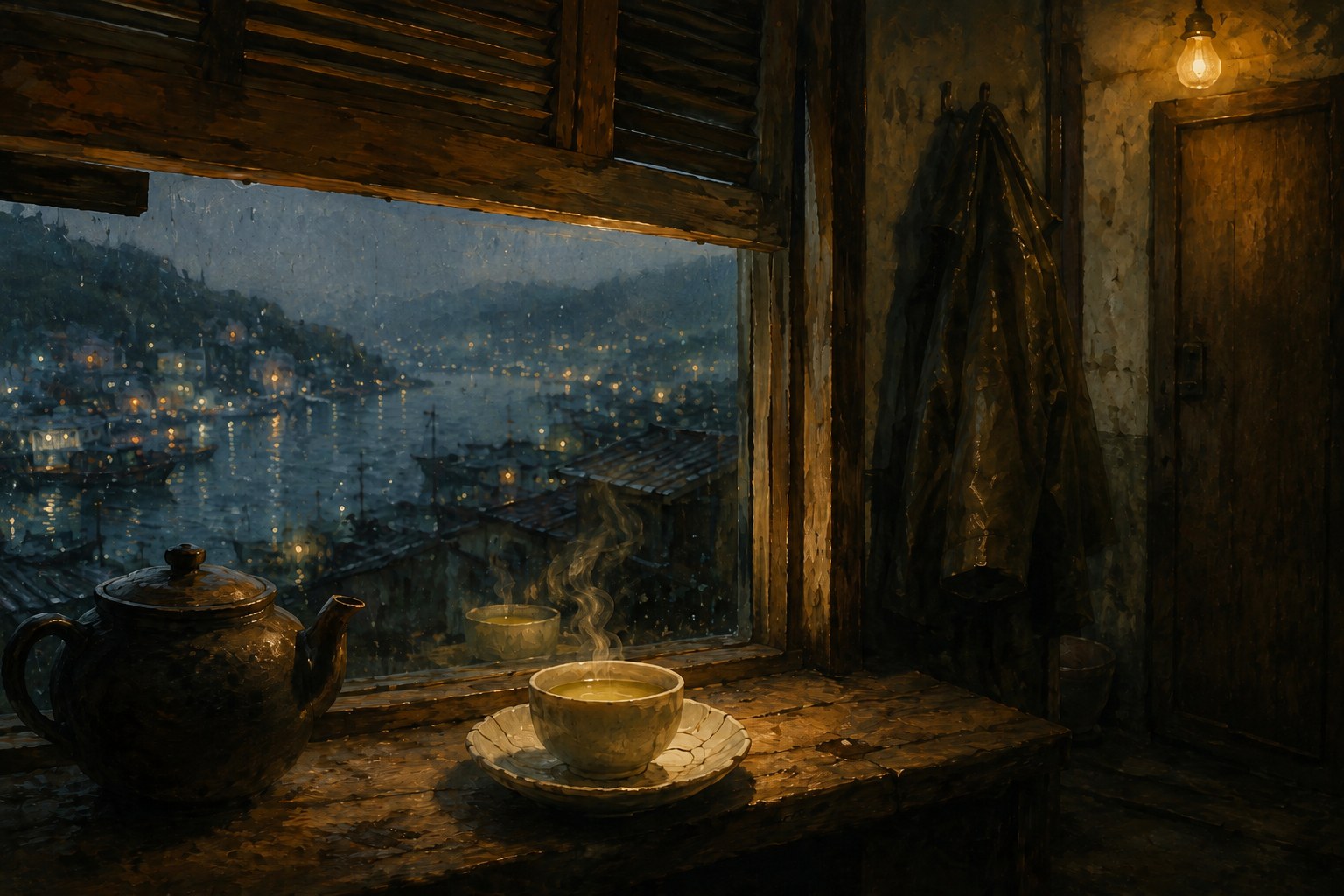
At six minutes past four on a morning of this kind of rain — paused, for the moment; the rain of Keelung does not stop, it steps out of the room — one kitchen window on a hillside lane above the harbour was lit.
The kitchen belonged to a man of fifty-seven who was awake at the wrong minute and did not know why.
His name was Lîm Hué-thô͗, and for forty-three years he had made tea in the same way at the same hour, which is to say he had turned tea-making into one of those instruments so precise they are only noticed when they fail. A monastery has bells. A harbour has tide tables. Hué-thô͗ had a clay pot, a tin of paozhong from the mountains behind the city, and a count he no longer counted because his hand did the counting for him — a hand educated at fourteen on the deck of his grandfather’s boat, where he had learned that a man who cannot wait six more seconds for tea will one day fail to wait six more seconds for something with a propeller in it.
This morning, at 4:04, his hand had jumped. The pour came six seconds early.
Six seconds does not sound like much. Six seconds is nothing to a city; a city mislays whole decades and puts buildings on top of them. But a habit forty-three years deep is a kind of ledger, and a ledger notices what a city does not. The first cup came in at strength — early, urgent, everything the leaf had, surrendered at once. Which meant the second cup, poured on the same leaves, was only water.
Hué-thô͗ stood at the window and looked at the second cup for a long time.
The correct response was obvious. Throw it out, re-steep, lose four minutes, arrive at the boat with the morning repaired. The cup steamed faintly, in no hurry, the way only genuinely pointless things can afford to be. Beyond it, through the slatted shutter, mountain air came down cold off the hills, and the harbour below made its usual sound of water negotiating with concrete.
He drank the wrong cup.
He drank it because it existed, and because he had made it, and because a routine you abandon the moment it stops making sense was never a routine — it was a convenience wearing a routine’s clothes. He drank the water that had been tea, all of it, and set the cup back on its cracked saucer on the sill, and the question he was not asking stood quietly behind him the whole time, like a guest too polite to mention the hour.
Something had woken him at the exact wrong minute.
Forty-three years, and his hand had never jumped.
He put on his oilskins.
II.
The lane down to Zhengbin harbour is one hundred and ninety steps, and Hué-thô͗ had an arrangement with each of them. He lit a Long Life under the last dry eave, in the manner of a man performing minor maintenance on himself, and walked the rest of the way in the almost-rain, past shuttered shopfronts and one vending machine that glowed with the serene confidence of the only thing awake on the street that was being paid for it.
His nephew was already at the boat, shovelling ice.
The boat was called Hái-chhun — Sea-Spring — and it had been his grandfather’s boat, in the sense that a very old axe has been in the family for generations and has had four new heads and six new handles. Rebuilt twice, re-engined three times, the same boat the whole while. His grandfather would have recognised nothing on it except the name and the small red-and-gold Mazu shrine bolted to the wheelhouse, and would have inspected the name for spelling and the shrine for dust, in that order.
Hué-thô͗ touched the shrine with two fingers, which was not superstition. Superstition is what other people have. This was procedure.
In the stern, wedged upright in the ice crate between yesterday’s emptied baskets, wrapped in cloth and tied with sisal string, sat the jar.
He had not wanted the jar. Wanting had not come into it. A fortnight ago the old widower from the lane behind the temple — a Japanese-era man, the kind who apologised to doorframes — had stood at the quay wanting two cuttlefish and holding no money, and Hué-thô͗ had given him the two and waved him off, because his own grandfather had spent a lifetime being owed things by men who died still owing them, and Hué-thô͗ had decided at some point to run that ledger in the other direction. Then yesterday the widower’s granddaughter had come to the boat with the jar and a message recited with the care of a girl delivering it exactly once, exactly right: He says this settles it. And he asks one kindness. The third floor of the building three streets back from the fish market. He says the man there will know.
The jar was three hundred millilitres of glass with a wax-paper lid, and under the wax paper, dark as riverbed stones, umeboshi — salted plums, eight years old. On the label, in careful kanji written by a hand that had plainly taken one breath before every character: For my late wife. June, 2018.
Eight-year umeboshi is not food. It is time, salted. In certain shops in Taipei a jar like this would buy a month of a fisherman’s life, and both Hué-thô͗ and the widower knew it, which was the entire grammar of the transaction: the debt of two cuttlefish repaid at a hundredfold, folded inside a request so small it made the repayment deniable. A man could eat it. It was his. That was precisely why he wouldn’t.
They cast off at 4:41.
At 4:47, Hái-chhun cleared the harbour mouth and swung east along the black waterfront, past the fold of streets where the Japanese had once kept their navy and the buildings still stood in their brick-and-tile rows like retired officers who saw no reason to slouch now. On the third floor of the second building from the corner, a window was lit.
Hué-thô͗ did not look at it.
This requires explanation, and will not get one — not from him. Forty years ago, a younger Hué-thô͗, running his grandfather’s boat out on this same heading, had noticed that one window in that fold of streets was lit at four in the morning. It had been lit the next morning. It had been lit every working morning since, through typhoons, through elections, through the death of his grandfather and the rebuilding of the boat and the marriage of his daughter, one lozenge of light in the black cliff of the town, and at some point in the first year of noticing it he had made a decision of the kind that never announces itself as a decision: a working man minds his own water. He had not looked at it since. It rode at the corner of his eye every morning of his working life, the way the mass of a mountain rides at the corner of a valley, and every morning he gave it the same courtesy he gave the drowned — he knew where it was, and he did not say its name.
In the window, this particular morning, a shadow moved the way a shadow moves when a man is writing.
Hué-thô͗ held his heading. The town slid past. Zero looks, in forty years — a number he had never once counted, which is the only way that number survives.
III.
The day was a working day, and the sea ran the way it runs when the Kuroshio leans its warm shoulder against the shelf of north Taiwan — which is to say generously, and without comment.
They worked the near grounds off Badouzi. Lines, jigs, the slow arithmetic of hauling. The mackerel came up first, then hairtail like ribbons of tin, and then, mid-morning, the other ones came over the rail: soft-bodied, silver-purple, and lit from inside. Each one, as it met the air, ran a last slow ripple of colour down its skin — bands of dark, bands of pale, a signal flare in a language nobody on the boat had ever claimed to speak — and then went still, and was inventory.
Hué-thô͗ had watched that ripple for forty years the way he watched rain: professionally.
The drizzle worked alongside them all day, too fine to name. The nephew re-baited with his hood down, humming a pop song about small rain in March that had been old before he was born. Hué-thô͗’s grandfather had owned one joke — exactly one, kept sharp like a tool, told on this water for fifty years, and always in his stiff market-Mandarin, because it did not work in the language the sea was conducted in. Fish and rain, he would say, holding a dripping catch up to the dripping sky. In Mandarin, one small tone apart — and Keelung never learned to pronounce the difference. That is why the nets fill here, boy. The sky is fishing too. We are what it catches. Fifty years, one joke. Hué-thô͗ had never once laughed. He had also never once, hauling fish out of the rain, failed to hear it.
Two of the largest he set apart, into the corner of the ice crate beside the jar, and did not explain to himself why, and was not the kind of man to press himself on the matter.
Between hauls he stood at the rail while the nephew re-baited, and his breathing did the thing it did when the sea was deciding something — in for a count of four, held for a count of eight, out for a count of seven. He had never noticed it. His grandfather had done it too, standing at this same rail when the rail was a different rail on the same boat. Certain kinds of patience are inherited the way boats are: rebuilt entirely, and the same.
They came in at 2:36 in the afternoon. He slept. At midnight his wife woke him with a hand on his shoulder and did not ask about the jar in the crate, because after thirty years of running the shore-side of a fisherman’s life she knew a delivery when she’d iced one. All she said was: You said you were taking it yourself.
IV.
There is a street in Keelung where the city keeps its river in the basement.
This is not a metaphor. Under the Sanliandong blocks, under the wet asphalt of Xiào 1st Road, the Xuchuan River still flows — a Qing-dynasty channel that once carried fishing sampans to stone stairs, until the government of 1978 looked at a working river and saw a parking problem, and capped the entire thing in concrete, and put buildings on it. The stairs are gone. The river is still down there, audibly unresigned. And on top of the buried river, six nights a week, from midnight until dawn, operates the loudest square kilometre in northern Taiwan: Kanziding, the fish market named — in Hokkien, by people with long memories — after the stone stairs the city buried. At the top of the stairs. There are no stairs. The name outlived the infrastructure, the way names do, the way the light outlasts certain stars.
Hué-thô͗ backed the truck down Xiào 1st Road at half past two in the morning into the middle of full industry.
Kanziding at that hour is what an ocean looks like after money has explained it. Fluorescent tubes on dripping tarpaulins. Styrofoam in white ziggurats. Hand-trucks with opinions about right of way. Rubber boots, cigarette smoke, shaved ice by the shovel, and over it all the voice of the Tiaoshou — the auctioneer — up on his wooden crate in the middle of the wet street, phone wedged under his jaw, singing prices in a compressed harbour Hokkien that goes too fast for outsiders on purpose. A Tiaoshou does not use a bell. A Tiaoshou is the bell.
Hué-thô͗ unloaded, stacked, squeezed a mackerel behind the gills for the benefit of a wholesaler who was watching him do it, and entered the economy.
From a transistor radio wedged behind a stall’s scales, half-drowned in the commerce, an old song played — the one about night rain on this harbour, written seventy years ago by a horn player three streets from here — and nobody was listening to it, which is the natural condition of that song, which is somehow also how it has stayed alive for seventy years.
The market dog, a brown mongrel the vendors called A-Hû, made his rounds with the gravity of middle management. The ice-boy shovelled, singing something in Bahasa to himself, sixteen floors of ocean moving through his shovel every night. The tea-runner, fourteen years old and the youngest working man on the street, threaded the crowd with a wire tray of 7-Eleven coffees held over his head like a procession. A grandmother in yellow rubber boots sorted hairtail by size with the speed of a card dealer. Above them all the buried river breathed its cold, canal-bottom smell up through the seams of the concrete, and nobody noticed, because nobody who works at Kanziding has ever once had time to notice the nineteenth century underfoot.
Baskets went past. Some of them held the silver-purple ones, still faintly pulsing under the fluorescent light, colour running its last slow bands over them like a message being read out to a room that had already started talking about something else.
At the crate-throne, the Tiaoshou drew breath and went up an octave.
“Nńg-si — hó-huè! Hó-huè!” Premium, premium — the soft-bodied ones, the good ones, and the price climbed the ladder of his voice two rungs at a time while three wholesalers bid with their chins.
Hué-thô͗, kneeling at his own crate with the tally-book his wife normally kept, counted his catch into the grid of her handwriting. Mackerel, forty-two kilos. Hairtail, thirty-one. And in the corner of the crate, iced apart, the two big ones for the third floor — hue-ki, his hand wrote, in the two characters his grandfather had taught him, 花枝, flower-branch, which is what his language calls the animal because of what its skin does at the end.
Cuttlefish, in the crate beside him, still pulsing colour under the fluorescent.
The market did not pause. The Tiaoshou did not pause. The river under the street did not pause. Somewhere in the crowd the tea-boy called out that the coffee was getting cold, which was true six nights a week and would be true tomorrow. It was 3:51 in the morning at the top of stairs that do not exist, and the word was simply there now, wet and ordinary on the page of a tally-book, the way a border is just grass until somebody tells you which country you are standing in.
At the far end of the row, the man who never spoke was packing up.
Hué-thô͗ had stood eleven metres from him for thirty years. He knew what everyone knew, which was nothing arranged into facts: the man’s crate of squid was always unusually well-ordered, packed the way type is set. His Mazu talisman was older than anyone else’s — older, said the grandmother in the yellow boots, than the temple’s own. His boat never seemed to need repair, which at Kanziding was discussed in the tone other neighbourhoods reserve for unexplained wealth. He bought nothing, sold a little, spoke to no one past the arithmetic, and left every working night at 4:20, and he left now, at 4:20, walking inland, three streets back, into the fold of brick buildings where the navy used to live.
Hué-thô͗ watched the space where he had been for a moment.
Then he closed the tally-book, took the two cuttlefish and the jar, and followed.
V.
The building was Japanese brick under sixty years of Keelung rain, which is its own architectural finish. Off the street, past two bridge pylons standing in the sidewalk — orphans of the buried river, holding up nothing, kept like grandparents — and into a stairwell that smelled of old paper, umbrella steel, and, very faintly, of salt.
One bicycle. One umbrella stand. A stairway of worn stone going up into dark that had a light at the top of it.
He climbed. Third floor. Under the door, a blade of warm light lay across the landing, and from behind the door came a sound he took a moment to place because it had been decades since he’d heard it: a pen. A real one, a nib, lifting and returning, lifting and returning, patient as rigging.
He set the jar down against the door, and the two cuttlefish beside it in their wet wrapping, and knocked once, and stepped back the width of the landing, which is what you do in Keelung when a delivery is not a conversation.
The pen stopped.
The door opened a hand’s width. Warm light came out of the gap and lay on the wet toes of his boots. A hand came out of the light and took the jar, and then the wrapped cuttlefish, without hurry — an old man’s hand, ordinary, or nearly ordinary, and the nearly was the kind of nearly that the eye files a report on and the mind declines to read.
A voice came out of the light. Old Hokkien, harbour-grained, the accent of a man who had learned it a long time ago from people who were no longer available for comment.
“Kám-siā.” Thank you. And then, as the door was already closing: “Tell him the debt ran the other way.”
The latch went home, softly. By the time Hué-thô͗ reached the second landing, the pen had already resumed.
Outside, the street was black and wet and empty, and the window was directly above him. Forty years of never looking up, and now he had been under the light itself, had watched it lie across his own boots, had carried salt to the hand that kept it burning — and it would have been the most natural thing in the world, one step out of the doorway, to tilt his head back and finally see.
He tilted his head down, instead, against the rain that was stepping back into the room.
And walked home.
VI.
By five, Kanziding was into its third shift of buyers — the retailers now, picking over what the wholesalers had left, and after them would come the leftover-pickers, and after them the sweepers, and by eight the street would be bare wet concrete over a hidden river, with no evidence that an ocean had passed through it in the night. The Tiaoshou’s voice had gone to gravel hours ago. He was still using it. A voice, at Kanziding, is a boat: you run it until dawn and repair it in the afternoon.
Three streets back, on the third floor of the second building from the corner, the light stayed on. It had been on for forty-three years, and it was on now over a table where a jar of eight-year umeboshi stood beside an inkstone, and a letter lay half-written in a careful, slightly slanted hand — a letter longer this morning than it had been yesterday, and the first letter in forty-three years that was not addressed to the person its writer had always, always written to. There is a very old poem about night rain, older than this harbour’s name, in which a man far from home bends over exactly such a letter, and the whole of it comes down to one line: you ask when I am coming back; there is no date yet. The rain outside his window had been asked the same question, by every roof in Keelung, for four hundred years. It had the same answer.
And on a windowsill on the hillside above the harbour, beside a shutter breathing cold mountain air, a cracked saucer held a second cup of tea that had long since gone fully cold. Which is to say the tea had given up being tea, and become water again. Which is to say it had already begun the long trip back — downhill, through the stone and the pipes and the buried patient river, out under the market and past the boats — to the sea, which keeps the ledger of such things, and forgets nothing it has steeped.