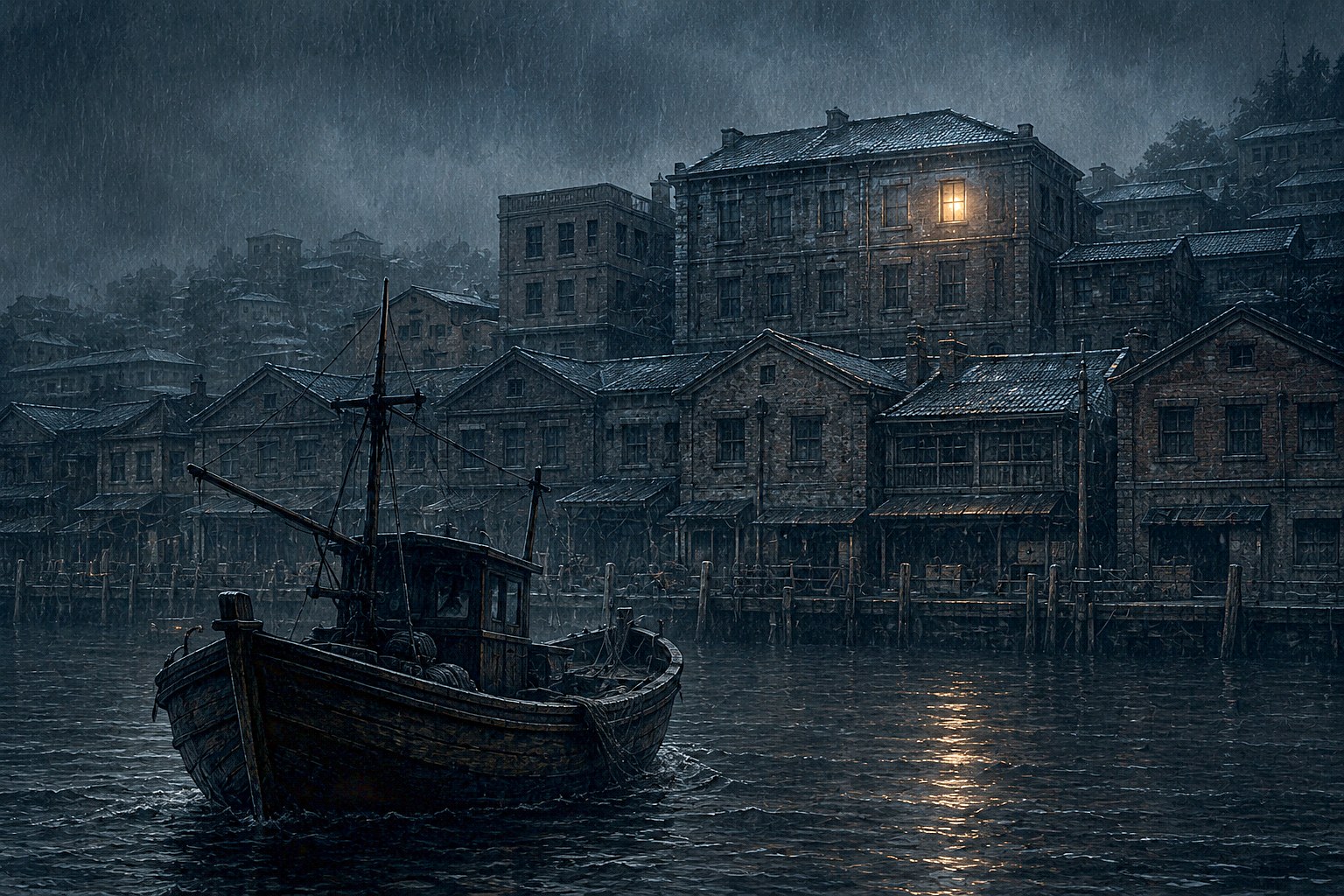
I.
There are men who cannot sleep, and there are men who have decided not to, and the difference between them is the difference between a leak and a decision. The first kind fights it. The second kind has furnished the hours.
The man on the third floor of the second building from the corner belonged to the second kind, and had for so long that the not-sleeping had stopped being an affliction and become, like the rain over Keelung, simply the weather he lived in. His room reflected the arrangement. A man who has been awake for a very large number of nights learns to make a small space answer for a life: one lamp, kept trimmed; one low table; an inkstone worn to a shallow bowl in its centre by the particular circular labour of a particular hand; a brush; a stack of paper that never grew and never emptied, because the rate at which he wrote and the rate at which he did not send had, over the decades, reached a kind of terrible equilibrium.
It was a few minutes past five. Somewhere below and to the north, the market he did not go to any more was into the shift where the poor picked over what the rich had left. He knew its clock without consulting it, the way you know the breathing of a person asleep beside you. He had, in fact, been to the market earlier — the row’s far end, where a man could stand and buy nothing and sell little and be, for two hours, merely another figure in rubber boots under the fluorescent tubes. He had left at twenty past four, as he left every working night, because a habit is a kind of wall and a man who has decided not to sleep needs walls.
On the low table, where a younger and more careless man would have set down his keys, sat a jar.
It had arrived an hour ago, delivered against his door by a fisherman who had knocked once and stepped back the width of the landing, which was the correct thing to do and which the man had noted with the small private approval he reserved for people who understood that some exchanges are not conversations. Three hundred millilitres of glass. A wax-paper lid. Under the paper, salted plums gone the colour of riverbed stones. And on the label, in a careful, slightly slanted hand that had plainly taken one breath before each character: For my late wife. June, 2018.
Beside the jar, two cuttlefish, still cold in their wet wrapping. He had not decided yet what to do with those.
He set the jar next to the inkstone, where the lamp could reach it, and for a moment the two objects sat side by side — the stone he had worn hollow with ink, and the glass someone else had filled with time — and if you had been in the room, and if the man had cast the shadow the lamp should have given him, you would have seen two shadows lie down together on the wall. You would have seen only one. It was the sort of thing the eye files a report on and the mind, sensibly, declines to read.
He sat. He uncapped the brush.
He had a letter to finish.
II.
This was the remarkable thing, the thing that would have surprised anyone who knew the shape of his nights: he could finish it.
The letter was to the widower — the old man three lanes over who apologised to doorframes, who had come to the quay a fortnight past wanting two cuttlefish and holding no money, and to whom the fisherman had given the two and waved off the debt. The man on the third floor knew this because the man on the third floor knew, in the patient exhaustive way of someone with nothing but time, most of what moved through the streets below his window. He knew the widower. He had known the widower’s wife, a little, before June of 2018. He had known, decades before either of them, the widower’s grandfather — but that was the long account, the one that ran underneath, and it was precisely the reason the jar had come to his door and not stayed in the fisherman’s kitchen where a jar of eight-year umeboshi would have bought a month of good living.
The debt, you understand, ran the other way. It always had. The widower believed he was repaying a kindness. He was in fact being repaid one, so old and so quietly carried that the repayment could be disguised as a gift and the gift disguised as a request and nobody’s pride need be troubled. This was a craft. The man on the third floor was, whatever else he was, a craftsman of the unsaid.
He wrote three lines. He thanked the widower for the salt. He said something about the wife — not much, the right amount, the amount a stranger is permitted — and he found, writing it, that the sentence came. That it closed. That the brush lifted at the end of it and returned to the next character and lifted again, patient as rigging, the way a brush is supposed to move when the hand behind it and the heart behind the hand are, for once, pointed at the same place.
He signed it with a mark that was not his name.
He folded it. He sealed it. And there it was on the table: a finished thing. A letter that could go. Tomorrow he would leave it where the widower’s granddaughter would find it, and she would carry it, and the old man would read it, and the account — one small corner of the enormous account — would be, at last, square.
He looked at it for a while.
Then he did the thing he did on the nights the finished letters undid him. He looked, without meaning to, at the drawer.
III.
Under the low table there was a drawer, and in the drawer there were letters, and the letters were to the one he had always written to.
He did not open it. He had no need. He knew its contents the way the fisherman two streets down knew the position of a certain window without ever looking at it — by long refusal, which is its own kind of intimacy, more faithful than attention. He knew there were forty-three years of them. He knew that not one was finished. He knew that not one had been sent, and that not one had been thrown away, and that these two facts had lived side by side in the dark under his table for longer than most of the people now asleep in Keelung had been alive, and that they did not trouble each other, because a thing you cannot finish and a thing you cannot discard are not enemies. They are the same grief, wearing its coat two different ways.
He took a fresh sheet. He wet the brush.
He got, tonight, as he got most nights, three lines in.
The first line was easy; it was always easy; it was the address, the turning of the whole body of the letter toward the one person it was for, and his hand had made that turn so many thousand times that it made it now the way water finds the old channel. The second line was harder and he made it anyway. The third line began to approach the place.
The place had a year on the far side of it.
He did not write the year. He had never written the year. In forty-three years of letters that reached, at their longest, four lines and, at their most honest, one, he had never once crossed into the sentence where the year lived, because the year was not a fact he was withholding — that would have been easy, a matter of discretion, and he was very good at discretion. The year was a room he could not enter. He had spent four decades standing in its doorway with a lamp, and the lamp showed him the threshold and nothing past it, and every night he wrote himself up to the threshold and every night the brush lifted—
—and did not return.
He sat with the brush raised over the paper and the third line unfinished, the ink drying on the bristles, and the rain going about its patient business on the roof, and the lamp holding, and the two shadows that were one shadow lying still on the wall, and he waited, as he had taught himself to wait, for the thing on the other side of the year to become something he could put a word to.
It did not. It never did. That was the arrangement. That was the whole of the arrangement, and he had made it, and he kept it, because the alternative to standing in the doorway of that year was to close the door on it, and closing the door meant deciding that the one he wrote to was not coming, and he had decided, forty-three years ago, that he would rather write letters that could not be finished than believe a thing that could not be borne.
He set the brush down. The third line stayed a third line.
IV.
To have something to do with his hands, which after a certain number of hours will ask, he reached over and worked the wax paper off the jar.
The smell came up — salt and plum and the particular deep sourness of eight years, a smell like a cellar that has been kept honestly — and he took one of the dark stones out and put it in his mouth.
It was very good. It was better than good; it was made by a hand that had understood salt as a way of speaking to time, that had packed each plum knowing the mouth it was meant for might be years away and might, in the end, never arrive, and had done the work anyway, correctly, out of a love that does not require its object to be present in order to be spent. He held the salt on his tongue and it tasted, as everything that mattered tasted to him, faintly of a year he would not name.
He thought — he permitted himself this much, once, quietly — that he and the widower were in the same trade. Salt for a mouth that would not come to it. Ink for an eye that would not read.
Neither of them was mad. Neither of them was even, particularly, sad, in the way the word is usually meant. This was not hope — hope wanted an outcome. It was quieter than hope, and more durable. It was the salt.
He ate a second plum. He capped the jar. He put the wax paper back, folding it along the creases the maker had made, because a thing made carefully asks to be closed carefully, and he was a man who returned that courtesy.
V.
Why the lamp never went out; why forty-three years; why a man of his particular and considerable capacities had chosen a fishing town and a small room and a stack of paper that neither grew nor emptied — these were not questions he asked himself, because he had answered them so long ago that the answers had become the walls, and you do not interrogate the walls of the room you have decided to live in. You tend them.
So he tended. He trimmed the lamp a fraction, though it did not need it. He squared the sealed letter — the one that could go — against the edge of the table, so it would be the first thing his hand found in the morning. He set the unfinished letter — the one that could not — face down, which was not the same as putting it away, and which he had never once mistaken for putting it away.
The two cuttlefish he took, still in their wrapping, and set outside the door on the stairwell sill, for the cat. There was a cat. There had been, for a long time, a cat — grey, and disinclined to explain itself — and he fed it, and it allowed this, and the two of them had never made more of the arrangement than it was.
And then he sat, and let his breathing do the thing it did in the last part of the night, when the deciding was over and only the keeping was left: a slow draw in, held long past the point where a land creature would have needed to let it go, and then out, unhurried, complete. In. Held. Out. The rhythm of a thing built to wait in the dark and to spend as little as possible while waiting — to hang perfectly still in the cold weight of a great deal of water and let the world come to it, and to be patient, above all to be patient, because patience was the one currency he had never run short of and the one, he sometimes suspected, that had cost him everything else.
He held the breath a long time.
The lamp held with him.
Outside, four hundred years of harbour rain went on asking the roofs of Keelung the only question it had ever asked, and getting, from each of them, the same answer it had always got.
VI.
Down at the ferry pier, in the last dark before the late-winter light, a bell rang.
It was a small, bright, particular sound, and it was the sound a bicycle makes, and it was not a bicycle. The man on the third floor could not have told you how he knew that — could not have told you why a bicycle bell heard across three streets of sleeping town should land in him as a thing to be filed rather than dismissed — but he knew it the way, an hour earlier, a fisherman on a hillside had known that a cup poured six seconds early was not nothing. Something had come into the city. Or was about to. The bell had the wrongness of a sound arriving from a little outside the ordinary supply of sounds, and he registered it, and set it down in the place where he kept the things he did not yet understand, which was not a large place, and which had been almost empty for a very long time, and which now held one thing.
He did not go to the window.
He did not look toward the harbour.
He had trained himself, over forty-three years, not to look toward the harbour — for the same reason a fisherman a little way up the hill had trained himself never to look up at a certain light; because there are directions a working person simply agrees not to face, and keeps the agreement daily, and the keeping is the whole of the discipline and very nearly the whole of the person. The harbour was where things arrived from. He had decided, a long time ago, in the doorway of a year he would not name, that he would not watch the harbour, because to watch the harbour was to wait in the wrong way — the way that wanted an outcome — and he had given up that way of waiting so that he could survive the other.
So he sat with his back to the water, in the lamp that would not go out, with a sealed letter that could go and an unfinished one that could not, and he let the bell be a thing he had heard and would think about later.
The rain stepped back into the room.
The light stayed on, as it had stayed on for forty-three years, over a small table where two kinds of keeping lay side by side under one steady flame — the salt and the ink, the finished and the unfinishable, the offering that had found its address and the offering that was still, after four decades, being made into the space where an answer used to be — and the harbour, behind him, unwatched, went on delivering the morning to a city that did not yet know it had a guest.